
How AI automates urgent care claims—boosting clean claim rates, cutting denials and A/R days, and improving revenue with oversight.
AI-driven claims submission is transforming how urgent care centers handle insurance billing. By automating tasks like data entry, eligibility checks, and coding, these systems reduce errors, speed up processing, and improve financial outcomes. Key benefits include:
AI tools like Ottehr streamline workflows by integrating clinical documentation, coding, and billing into one platform, reducing manual intervention. However, success depends on accurate data and regular audits to mitigate risks like automation errors or poor data quality. Transitioning to AI involves assessing current processes, preparing systems, and running a pilot program before scaling up.
For urgent care providers, adopting AI claims submission is a practical way to improve efficiency, reduce costs, and enhance patient satisfaction.
AI-powered claims submission offers a streamlined process that reduces errors and saves time. Here's how the workflow unfolds, with AI playing a pivotal role at every step.
Everything starts with accurate data. AI tools integrated into Electronic Health Record (EHR) systems automatically capture patient information like demographics, insurance details, and clinical notes in real time. This eliminates the need for manual data entry, reducing the chance of human error.
Using Natural Language Processing (NLP), AI reviews clinical notes and checks them against payer requirements. It flags issues like missing diagnoses or insufficient service justifications before the claim is even created. This proactive review acts as a built-in quality control, minimizing the risk of denials later in the process.
Once the data is clean and complete, the system moves to AI-assisted coding.
AI takes over coding by assigning ICD-10 and CPT codes based on the documented patient encounter. It then validates these codes against payer-specific rules, the National Correct Coding Initiative (NCCI) edits, and live payer guidelines.
"Our AI claim agent scrubs CPT, ICD-10, and HCPCS codes against live payer edits at the point of submission." - MedCare MSO
AI systems continually improve by learning from past claim rejections. This adaptive approach has led to impressive results, with organizations reporting a 97.9% reduction in claims processing time and an 82.6% drop in denial rates.
Validated codes ensure the process can move seamlessly to claims generation.
Once coding is validated, AI assembles the claim in the ANSI 837 format and performs one last pre-submission check. Claims flagged as high-risk are held back for manual review, avoiding unnecessary rejections. This is critical, as reworking a single rejected claim can cost between $25 and $118, and U.S. healthcare organizations spend an estimated $262 billion annually on claim rework.
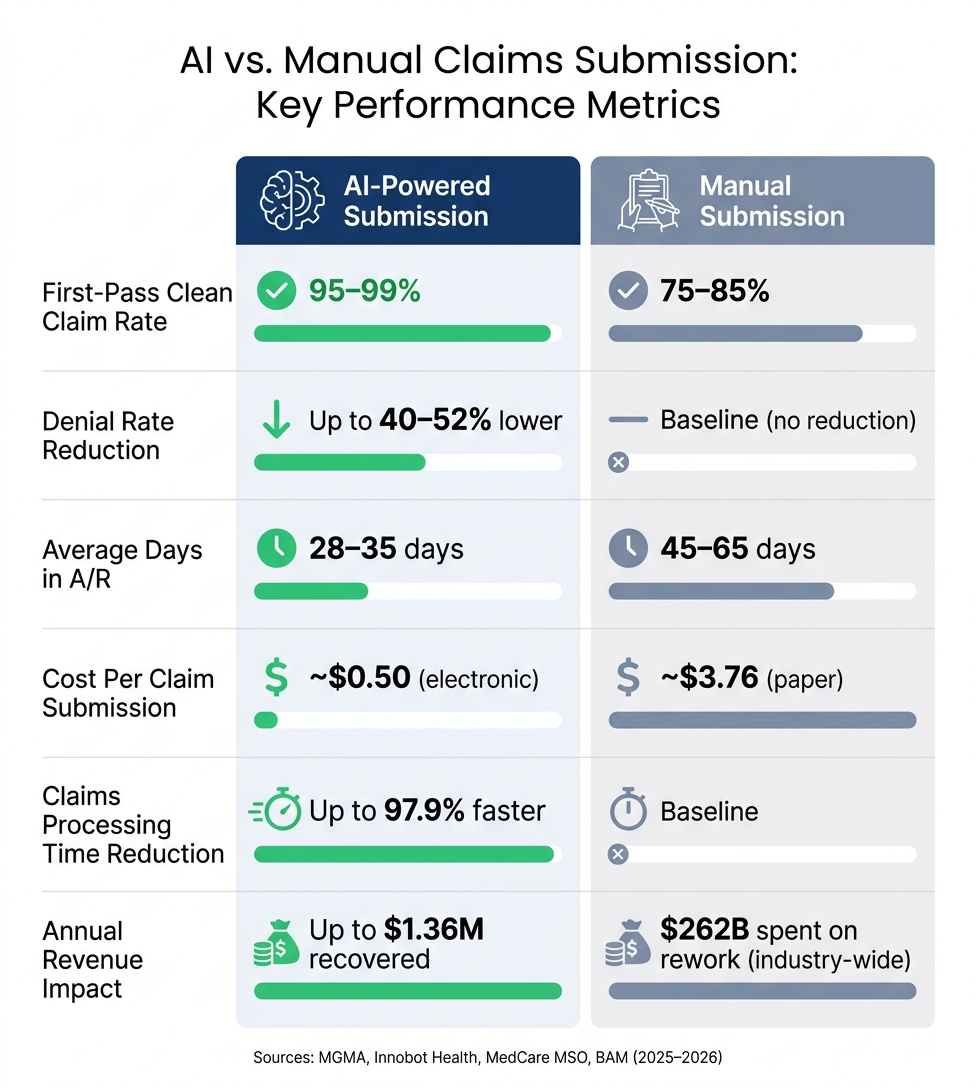
AI vs. Manual Claims Submission: Key Performance Metrics
AI claims submission has shown impressive results in improving financial performance for urgent care practices. For instance, practices have reported 30–50% better clean claim performance and a 40% reduction in denials within the first year of implementation. Additionally, AI can cut accounts receivable days by 10–15, translating into $65,000–$100,000 in accelerated cash flow for a practice with a monthly collection of $200,000.
One striking example comes from March 2026, when a healthcare organization using an AI claims platform achieved a 52% reduction in denial rates and a 60% faster average payment time, leading to an estimated $1.36 million in recovered and new revenue annually. Similarly, Innobot Health documented a 667% ROI in the first year of adopting AI-driven claims processing.
"AI claims processing automates the most labor-intensive and error-prone stages of the healthcare billing lifecycle." - Natasha Schlinkert, Founder & CEO, Innobot Health
Beyond financial gains, AI enhances operational efficiency, allowing practices to focus more on patient care and less on administrative bottlenecks.
AI simplifies billing by automating repetitive tasks like data validation, eligibility checks, and rule-based scrubbing. This reduces billing errors, which are often the cause of surprise bills and delayed explanations of benefits for patients.
"AI claim submission automates the mechanical parts of billing - the data validation, the rule checking, the submission - and frees your team to handle the work that requires human intelligence." - Heph, AI COO at BAM
When claims are processed correctly on the first attempt, the payment cycle speeds up, and patients experience fewer misunderstandings about their out-of-pocket costs. This alignment of financial efficiency with patient satisfaction builds a more resilient and patient-friendly billing process.
While the benefits are clear, it's equally important to address potential risks. One major concern is over-reliance on automation. If payer rules are misinterpreted or data is incorrect, errors can quickly multiply across claims.
Another significant risk is poor data quality. AI systems rely on accurate and up-to-date information, and issues such as incomplete patient demographics or outdated insurance details can lead to denials. According to a 2026 MGMA poll, 48% of revenue loss in urgent care is linked to denials and appeals, underscoring the importance of getting data right.
The solution isn't to avoid AI but to ensure it is supported by regular audits and human oversight. Staff should critically evaluate AI outputs rather than relying on them blindly. Additionally, establishing a strong data validation process before claims reach the AI system is essential. As Adam Morris, CPC at Charta Health, explains:
"The operators pulling ahead are the ones who have stopped trying to patch the old workflow and started rebuilding the revenue cycle around AI technologies that eliminate preventable errors."
Breaking down the process of adopting AI claims submission into three phases - assessment, preparation, and piloting - can simplify implementation.
Before introducing AI into your claims workflow, take a close look at how your current process operates. Start by analyzing key metrics like denial rates, average days in accounts receivable (A/R), and first-pass clean claim rates. These figures will serve as your baseline, helping you measure progress once AI is integrated.
Dig deeper into the reasons behind claim denials. Are they caused by eligibility issues, coding errors, or incomplete documentation? Pinpointing these root causes will help you identify where AI can make the biggest difference. For example, manual processes typically achieve clean claim rates of 75–85%. AI systems aim to bridge this gap, offering the potential for much higher accuracy.
Once you’ve established your baseline and identified pain points, the next step is to prepare your systems and data for the transition.
After identifying where your claims process falls short, ensure your infrastructure can support AI integration. Start by verifying that your electronic health record (EHR) system is compatible with AI technology. Also, confirm that payer data, fee schedules, and patient records are up-to-date and accurate.
Switching to electronic claims submission can significantly reduce costs and speed up payments. Submitting claims electronically costs around $0.50 per claim, compared to $3.76 for manual submissions. Additionally, practices using electronic claims submission often receive payments 7–14 days faster than those relying on paper forms. If your current systems aren’t optimized for electronic submissions, this is a crucial area to address. Ottehr’s revenue cycle management features, for instance, are designed to integrate seamlessly with existing payer and clearinghouse networks, leveraging a FHIR-native architecture.
Once your systems are ready, it’s time to test the AI workflow in a controlled environment.
Start with a pilot program, applying the AI workflow to a specific subset of claims for 30 days. This controlled approach allows you to gather enough real-world data to assess the system’s performance without risking the entire revenue cycle.
During the pilot, monitor metrics like clean claim rates, denial rates, and A/R days closely. Collect feedback from billing staff to identify any challenges or friction points. For example, one multi-specialty practice saw a 40% reduction in denial rates and a drop in A/R days from 30 to 15 after adopting AI-driven claims processing. This shift also allowed billing staff to focus on more complex cases.
If the pilot delivers consistent success, expand the system across your practice. Be sure to provide structured training for staff to ensure they understand the new workflow and know how to handle exceptions flagged by the AI.
Once you've piloted AI claims submission, the next step is to focus on refining the process. Measuring performance is essential to ensure the system delivers results and to identify areas for enhancement. Tracking the right metrics will separate practices that thrive from those that lag behind.
Four metrics stand out when evaluating AI claims submission: denial rate, first-pass acceptance rate, average days in accounts receivable (A/R), and cost per claim. These indicators provide a clear picture of your system's effectiveness. For example, practices using AI-driven claims submission often achieve first-pass acceptance rates of 95–99%, a significant improvement over the 75–85% industry average seen with manual processes. Similarly, automated workflows reduce average A/R days to 28–35 days, compared to the 45–65 days typical of manual systems.
Breaking down denial rates by specific reasons - such as eligibility issues, coding errors, or missing documentation - allows you to pinpoint problem areas. Addressing these root causes, rather than merely resubmitting claims, ensures long-term improvements. These metrics provide actionable insights for immediate and targeted corrective actions.
While AI can streamline processes, it doesn't eliminate compliance risks. Instead, it shifts the focus of those risks. Practices remain accountable for adhering to HIPAA regulations and payer rules, even when AI handles much of the workload. Regular coding audits are essential to catch patterns of miscoding or misinterpretation.
"The goal is not full automation for its own sake, but a smarter, more resilient revenue cycle that combines the strengths of both technology and human judgment." - Kimberly Hardin, Senior Vice President of RCM Operations, Experity
A balanced approach, where staff review flagged claims and periodically audit automatically approved ones, strengthens compliance efforts. Additionally, setting up alerts for filing deadlines can help prevent revenue loss from missed submissions - one of the most avoidable issues in the claims process.
AI systems become more effective over time by learning from patterns in denied claims. To maintain this improvement, it's crucial to update the system's data and validation rules as payer requirements evolve. Regularly refining eligibility checks and claim scrubbing can result in a 40% decrease in denial rates and a 30% boost in clean claim rates.
As your practice scales, insights from denial trends and documentation gaps can help refine both operational workflows and clinical documentation. This ensures that growth doesn't compromise efficiency. Platforms like Ottehr, designed with FHIR-native architecture and revenue cycle management tools, make it easier to manage multi-site operations without the hassle of separate implementations. Leveraging these insights can drive ongoing improvements across your organization.
Managing billing in urgent care is a fast-moving, high-pressure task. Even a single coding mistake or overlooked eligibility check can lead to a denial, costing your practice $25–$50 to fix. AI-powered claims submission addresses these challenges by replacing manual, error-prone processes with automation tools like real-time eligibility checks, intelligent scrubbing, and automated validation.
The numbers speak for themselves. Practices leveraging AI for claims submission achieve first-pass acceptance rates of 95–99%, compared to the 75–85% typical of manual systems. Denial rates drop by 40% or more, while clean claim rates improve by 30–50% . These results represent a major shift in how revenue cycle management can operate.
"The operators pulling ahead are the ones who have stopped trying to patch the old workflow and started rebuilding the revenue cycle around AI technologies." - Charta Health
For practices ready to embrace this change, Ottehr offers a practical solution. Its FHIR-native platform integrates claims submission and denial management tools, reducing administrative work without requiring a complete overhaul of your systems. Users report an 80% reduction in time spent on claims tasks, aligning with the efficiency improvements discussed in this guide. With straightforward pricing at $1.50 per claim for full revenue cycle management (RCM) services, it's easy to weigh the cost against your current denial-related expenses.
The path forward is clear: start with a high-impact process like eligibility verification, track the outcomes, and expand from there. With implementation timelines as short as 6–8 weeks using an overlay approach, transitioning to a smarter revenue cycle is more achievable than many practices realize.
AI claims submission relies heavily on how well your EHR system handles interoperability and integration. Many modern EHRs use standard formats like X12 837 or FHIR-based APIs to facilitate data exchange. If your EHR supports these formats, integration is generally achievable. For instance, Ottehr offers a FHIR-native platform with built-in claims submission tools, streamlining workflows for clinics that want a more efficient solution.
AI systems function as a digital compliance layer, using specialized pipelines to validate claims against payer-specific rules and instantly flag errors. These automated tools can even recommend ICD-10 and CPT codes based on clinical notes. However, human review remains essential to ensure these suggestions are accurate.
Validation agents also play a crucial role by checking the alignment between diagnoses and procedures. They reject clinical mismatches, ensuring accuracy while relying on human oversight for more complex scenarios, such as handling denials or appeals. This blend of automation and human input helps maintain precision without sacrificing efficiency.
To see the return on investment (ROI) for AI-driven claims submission within the first 30 days, focus on tracking these key performance indicators (KPIs):
These metrics provide a clear picture of how well the system improves efficiency, reduces errors, and speeds up reimbursements.

Tell us what you need and we'll get back to you soon.