
Compare urgent care RCM options by workflow fit, eligibility checks, denial handling, and pricing—flat vs percentage models.
If you run urgent care, billing delays can drain cash fast. A center seeing 40 patients a day can send 1,000+ claims per month, so even a small denial rate can block a lot of revenue.
I’d sum up the article like this: Ottehr RCM is the top pick for urgent care if you want urgent care-focused billing, flat pricing, and automation across eligibility, claims, denials, and patient billing. The other options - athenaOne, AdvancedMD, CareCloud Concierge, DrChrono, and eClinicalWorks - each have solid billing tools too, but they differ most on workflow fit, front-end eligibility, denial handling, and pricing.
If I were comparing these services, I’d focus on:
Key numbers from the article:
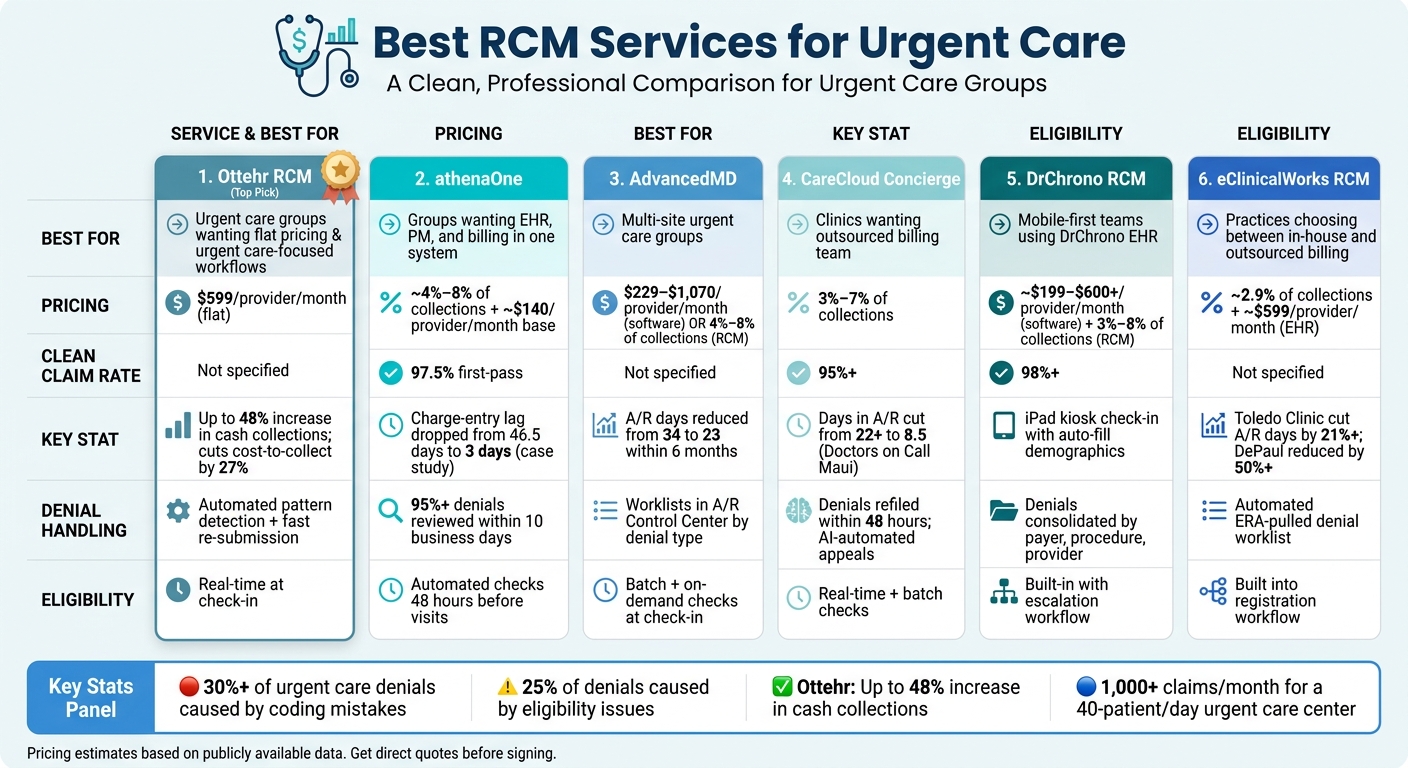
Best RCM Services for Urgent Care: Side-by-Side Comparison
| Service | Best For | Pricing Style | Main Point |
|---|---|---|---|
| Ottehr RCM | Urgent care groups that want flat pricing and urgent care-focused workflows | $599/provider/month | Best overall fit for urgent care in this review |
| athenaOne | Groups that want EHR, PM, and billing in one system | % of collections + software fees | Strong claim rules and payer rule engine |
| AdvancedMD | Multi-site urgent care groups | Software fee or 4%–8% RCM | Centralized billing and A/R tools |
| CareCloud Concierge | Clinics that want outsourced billing help | 3%–7% of collections | Managed billing team handles more of the work |
| DrChrono RCM | Mobile-first teams using DrChrono’s EHR | Software fee + 3%–8% RCM | Strong mobile workflow and urgent care templates |
| eClinicalWorks RCM | Practices choosing between in-house and outsourced billing | Software fee + about 2.9% RCM | Flexible service model inside eCW |
So if you want the short answer, this article ranks Ottehr first because it lines up best with urgent care’s day-to-day billing needs: fast eligibility checks, cleaner claims, lower denial risk, and a cost structure that’s easy to forecast.
Ottehr RCM is built for urgent care teams that need configurable, FHIR-native billing workflows. That matters a lot in urgent care, where same-day visits call for fast eligibility checks and smooth claim movement.
Claims are generated automatically at sign-off and submitted through Candid Health. That helps automate registration, claim creation, and follow-up across the visit.
Ottehr reports lower cost-to-collect, faster reimbursement, and fewer denials from RCM automation.
That same setup can also cut front-end collection misses.
Ottehr automates eligibility verification during registration, so staff can confirm coverage before the visit starts. At check-in, staff can view balances, estimated patient responsibility, and deductible usage. That gives teams a better shot at collecting copays before the visit ends.
On the back end, Ottehr's denial management tools spot patterns in rejected claims and support fast re-submissions. Payment processing runs through Stripe. Ottehr reports that organizations combining outsourced RCM with automation have seen cash collections increase by up to 48%.
For urgent care operators weighing automation against staff time and admin workload, Ottehr RCM costs $599 per provider per month. The price includes claims submission, denial management, fee schedule management, patient billing, and RCM reporting.
Before launch, confirm who handles credentialing, claim follow-up, denial work, and reporting.
For urgent care groups that want billing linked closely to documentation and scheduling, athenaOne keeps the revenue cycle inside a single workflow.
athenaOne brings together EHR, practice management, RCM, and patient engagement in one urgent care platform. athenahealth says its urgent care billing rules are shaped by input from 3,500 clinicians and 10.3 million claims per year.
The platform supports the full urgent care visit cycle, from registration and documentation to charge capture and billing. Its athenaCollector revenue cycle piece uses more than 30,000 payer-specific rules that update on a continuing basis using network data. That helps catch coding errors and modifier issues before claims go out the door.
If a clinic also offers service lines like occupational medicine or telehealth, athenaOne can handle different billing rules inside the same system.
athenaOne can run automated eligibility checks 48 hours before scheduled visits and flag unverified coverage, giving front desk staff time to fix issues before the patient arrives. At check-in, registration and insurance verification workflows confirm demographics and coverage. Staff can also collect copays and estimated patient responsibility at the front desk.
On the back end, athenaOne aims to keep claims clean at submission and move quickly on denials. The company reports a 97.5% clean claim submission rate on the first pass and a 1.6% first-pass rejection rate for urgent care customers. athenahealth also says it reviews and acts on at least 95% of denials within 10 business days. If performance drops below that mark, the company offers a service credit equal to 2% of that month’s invoice for every 1% under the threshold.
In an Advanced Urgent Care case study, the clinic adopted automation-heavy workflows, including card-on-file processing and claim scrubbing. After that change, charge-entry lag dropped from 46.5 days to 3 days, patient collection rate increased from 43.2% to 95.0%, and billing lag fell by 26.4% between January 2024 and January 2025.
That setup comes with a different pricing model. athenaOne uses percentage-of-collections pricing. Third-party estimates place RCM fees at 4%–8% of collections, with base EHR and practice management starting at about $140 per provider per month. Optional engagement tools can add about $100–$200 more.
AdvancedMD brings claims, payments, and A/R into one cloud-based system for multi-site urgent care groups.
For urgent care operators with more than one location, that matters. Teams can standardize coding templates and billing rules across sites, then track daily collections from a single dashboard. Instead of each clinic doing its own thing, everyone works from the same playbook.
CommunityMed Urgent Care uses AdvancedMD's billing tools to streamline walk-in workflows and cut manual steps.
On the front end, staff can run batch eligibility checks before visits or do on-demand checks at check-in. That helps confirm coverage, copays, and deductibles before the patient is roomed. In plain terms, the clinic gets a clearer picture of what insurance will cover before care starts.
AdvancedMD also includes integrated credit card processing. That makes it easier to collect copays and patient balances at the point of service, instead of chasing them later.
After eligibility is confirmed, the next job is getting claims out cleanly and fixing denials without delay. AdvancedMD includes a built-in claim scrubbing engine that checks for coding mistakes and payer-rule issues before submission. That can help improve first-pass acceptance.
When denials do happen, they don't just sit in a pile. The platform sorts denied claims into worklists inside the A/R Control Center, which lets billing teams triage by denial type and work the highest-priority items first.
An external case study found that using AdvancedMD to manage claims and A/R reduced average A/R days from 34 to 23 within six months.
Cost is often the last screen for urgent care groups comparing vendors. AdvancedMD offers two main pricing paths:
The outsourced option covers claims handling, denial management, payment posting, and payer follow-up.
For urgent care groups that want a managed billing team, not just software, CareCloud Concierge takes more of the revenue cycle off your staff’s plate. It’s an outsourced RCM service that adds a billing team for coding, claims, denials, and A/R follow-up. In a busy urgent care setting, that can make a big difference.
CareCloud’s urgent care workflows are built for high visit volume, including minor injuries, acute illnesses, and occupational medicine. Automated billing rules help standardize charge capture across providers and shifts, which is a big deal when handoffs happen all day. Doctors on Call Maui cut Days in A/R from over 22 to 8.5 with CareCloud support.
The pressure point is often check-in. That’s where staff need to verify coverage and collect copays fast, without slowing down the front desk.
Concierge uses real-time and batch eligibility checks to confirm coverage, co-pays, deductibles, and authorization needs before the patient is seen. For walk-ins, staff can run a check during registration and know what to collect upfront. CollectiveIQ scrubs patient and insurance data at entry and sends repeat eligibility problems into denial queues.
Once registration is cleaned up, the next hurdle is simple: how fast claims go out and how denials get worked.
CareCloud reports an average clean-claim rate above 95%, driven by CollectiveIQ’s continuous updates from payers and clearinghouses nationwide. When denials happen, third-party sources say they are usually refiled within 48 hours. The cirrusAI Appeals feature automates appeal letters.
Concierge uses a percentage-of-collections model, usually 3%–7% of monthly collections, charged on top of the base software subscription. At a 5% rate and $800,000 in monthly collections, the RCM fee would be $40,000 per month.
That setup tends to make sense when outsourcing cuts denials or replaces in-house billing labor. If a practice already has a strong internal billing team, though, the math can get tight pretty fast.
DrChrono's RCM sits inside its cloud EHR and practice management platform. That means charge capture, claim submission, denial work, and patient collections all happen in one system. For urgent care, that cuts down on handoffs and helps visits move faster. You feel that most at registration and charge capture, where time starts slipping away first.
DrChrono offers a specialized UrgentCare EHR built for high-volume walk-in settings, with tools aimed at patient engagement, care delivery, and practice productivity. Providers can chart, capture charges, and submit claims from iPad, iPhone, or the web, which lines up well with the pace of walk-in care.
It also supports iPad-based kiosk check-in. Patients can enter their name and date of birth, and their insurance and demographic details then auto-fill into the EHR. That cuts front-desk typing and helps move registration lines faster.
On the billing side, urgent care teams can set up custom superbills and charge templates around common services like laceration repair, splinting, testing, and vaccinations. During a busy shift, that can help staff keep charge capture more consistent.
Once the visit is documented, the next pinch point is eligibility and point-of-service collection.
Eligibility checks are built into DrChrono's billing workflow, and higher plans add unlimited eligibility checks plus payment tools. Auto-run checks can be set to run before scheduled visits. There's also an escalation workflow that lets front-desk staff flag a chart for follow-up and mark it confirmed after a billing rep contacts the payer. That's handy when a payer issue can't be solved with a simple automated check.
DrChrono's managed billing service says it delivers a clean-claim submission rate above 98%, backed by real-time claim validation before submission. Its denial management tools pull denials into one place, with reporting that breaks down denial reasons by payer, procedure, and provider. Those workflow gains make it easier to compare DrChrono with the other urgent care RCM options below.
DrChrono's core EHR and practice management platform is sold as a subscription on a per-provider, per-month basis. Entry-level plans are often cited at around $199 per provider per month, while higher tiers usually fall in the $300–$600+ per provider per month range.
Full-service managed RCM is usually custom-quoted as a percentage of monthly collections, most often in the 3%–8% range. That percentage tends to go down as billing volume goes up. So the total cost includes the software subscription plus a share of collections.
Next, compare how these features stack up across urgent care RCM options.
Like other urgent care RCM options, eClinicalWorks connects front-end eligibility checks with back-end claims follow-up. Its RCM tools sit inside the same EHR and practice management platform, so billing, documentation, and front-desk tasks all happen in one system. That setup matters in urgent care. Charge capture flows straight from the visit, and claims move into the billing queue without manual re-entry.
eClinicalWorks offers two paths. You can use a self-service RCM model, where your in-house team runs billing through eCW’s tools, or a fully outsourced RCM as a Service model, where eClinicalWorks handles claim creation, submission, denial work, and collections.
The choice is pretty simple in practice:
That shifts attention back to the front desk, where eligibility and payment checks can make or break the visit workflow.
Eligibility verification is built into the registration process, which lets front-desk staff check active coverage, patient responsibility, and demographic errors before the visit moves ahead. In walk-in care, that’s a big deal. Patients often arrive without clear coverage details, so catching issues at check-in can save a lot of cleanup later.
Denied claims are automatically pulled from ERAs and sent to a dedicated denial worklist. From there, teams can sort denials by payer, reason, provider, or date of service, then move through review, correction, and appeal.
The numbers help show what that can look like in the field. Toledo Clinic cut A/R days by more than 21% year over year, and DePaul Community Health Centers reduced them by more than 50% across 12 centers. Those gaps in workflow and cost stand out more when you compare features side by side.
RCM as a Service is often cited at 2.9% of monthly collections, added to EHR/practice management pricing of about $599 per provider per month. Some bundles fall in the $699 to $799 per provider per month range, and an AI RCM add-on is reported at about $99 per provider per month. Before signing anything, get a direct quote. Pricing can shift depending on the bundle, service level, and add-ons you choose.
After the individual service reviews, the comparison comes down to four day-to-day issues: workflow fit, eligibility capture, denial speed, and total cost.
| Criterion | Why It Matters in Urgent Care | What to Look For | Urgent Care Takeaway |
|---|---|---|---|
| Urgent Care Workflow Fit | Urgent care runs on speed. The billing workflow needs to match that pace without a lot of extra setup. | Tight EHR/RCM integration, support for POS 20, CPT S9088, modifier -25, and walk-in queue management. | Ottehr is built for urgent care. Other platforms can support walk-in billing, but they need more setup to handle the same level of throughput. |
| Front-End Eligibility & Collections | Getting eligibility and patient payment details up front helps staff avoid headaches later. | Real-time eligibility at check-in, automated copay and deductible estimates, and integrated point-of-service payment tools. | Strong eligibility and digital payment workflows show up across these services, but the depth of setup and level of automation change from one platform to another. |
| Claims & Denial Performance | Clean claims and fast denial handling can make or break cash flow. | Claim scrubbing with urgent care-specific rules, automated denial work queues, and analytics by payer and denial reason. | Ottehr includes urgent care-focused coding and denial rules. Other services also offer analytics and denial workflows, but the results depend more on how the billing team works the system. |
| Pricing & Cost Structure | Pricing can look simple at first and get expensive fast if key services cost extra. | Understand what is included - coding, denial management, reporting, and credentialing - versus what costs extra. | Ottehr RCM is priced at $599/provider/month as a bundled plan. Other services use percentage-based or hybrid pricing with different items included. |
These criteria shape the practical tradeoffs urgent care operators need to weigh next.
Ottehr makes the most sense when you look at three things: patient volume, staffing capacity, and what you need most right now. For some groups, the big win is stronger front-end collections. For others, it's tighter denial control or less day-to-day admin work. This table keeps the focus on Ottehr's main operational trade-offs so you can see where it helps most - and where your team may still need to stay hands-on.
| Detail | |
|---|---|
| Strengths | Built for high-volume urgent care billing; real-time eligibility at check-in; end-to-end billing support; automation can reduce cost-to-collect by as much as 27%; flat-rate pricing at $599/provider/month |
| Trade-offs | Requires workflow alignment and internal oversight; open-source flexibility may require more internal technical support |
| Best fit | Urgent care groups that want automation, custom workflows, and a predictable cost structure tied to faster reimbursement, fewer denials, and lower admin burden |
The core call comes down to fit. If Ottehr's automation model and flat pricing line up with how your team is staffed and how you manage collections, it can take a lot of pressure off the billing side. If not, you may need more internal support to make the setup work well day to day.
Ottehr is the best match for urgent care teams that need fast eligibility checks, cleaner claims, and billing costs they can plan around. For most urgent care operators, those three factors tend to decide the choice: eligibility speed, claim accuracy, and cost predictability.
If denials are the main issue, put front-end eligibility first. If cash flow is under pressure, focus on point-of-service collections. If your team is buried in admin work, lean into automation.
Ottehr has supported more than 1,000,000 urgent care visits and can cut cost-to-collect by as much as 27%, with flat-rate pricing at $599/provider/month.
Urgent care centers can often see RCM results fast. Smarter RCM setup may take 6 to 8 weeks, and once it’s live, AI-driven tools can give teams immediate visibility through real-time dashboards.
Some AI coding solutions process 94% of claims within 24 hours. Many practices can also start tracking clean claim rates, denial rates, and other key metrics within the first 30 days.
Urgent care RCM services often cover the core billing tasks that keep cash flow moving, including:
Some providers also handle patient billing, fee schedule setup, charge master management, and financial reporting. That takes a chunk of admin work off your team’s plate and helps cut down on denials.
Often, yes. For high-volume urgent care clinics, flat-rate RCM can cost less than percentage-based pricing because it gives you a set monthly bill.
With percentage-based pricing, fees usually go up as revenue goes up. A fixed-fee model makes budgeting simpler and lets you see more patients without your billing costs rising at the same pace.
