
Prioritize visit flow over feature lists—compare top urgent care EHRs by throughput, AI charting, lab/eRx, and RCM.
If I were choosing an urgent care EHR in 2026, I’d sort the list by one thing first: visit flow. In urgent care, the best system isn’t the one with the longest feature list. It’s the one that keeps check-in, charting, lab orders, imaging, eRx, and billing moving without slowing the clinic down.
Here’s the short version:
I’d compare these systems on four points:
A few 2026 shifts matter here too. AI ambient notes can cut note time, FHIR-based data exchange can pull outside history during the visit, and telehealth now plays a bigger part in after-hours care and follow-up. On the billing side, even a small drop in denials can matter when margins are thin.
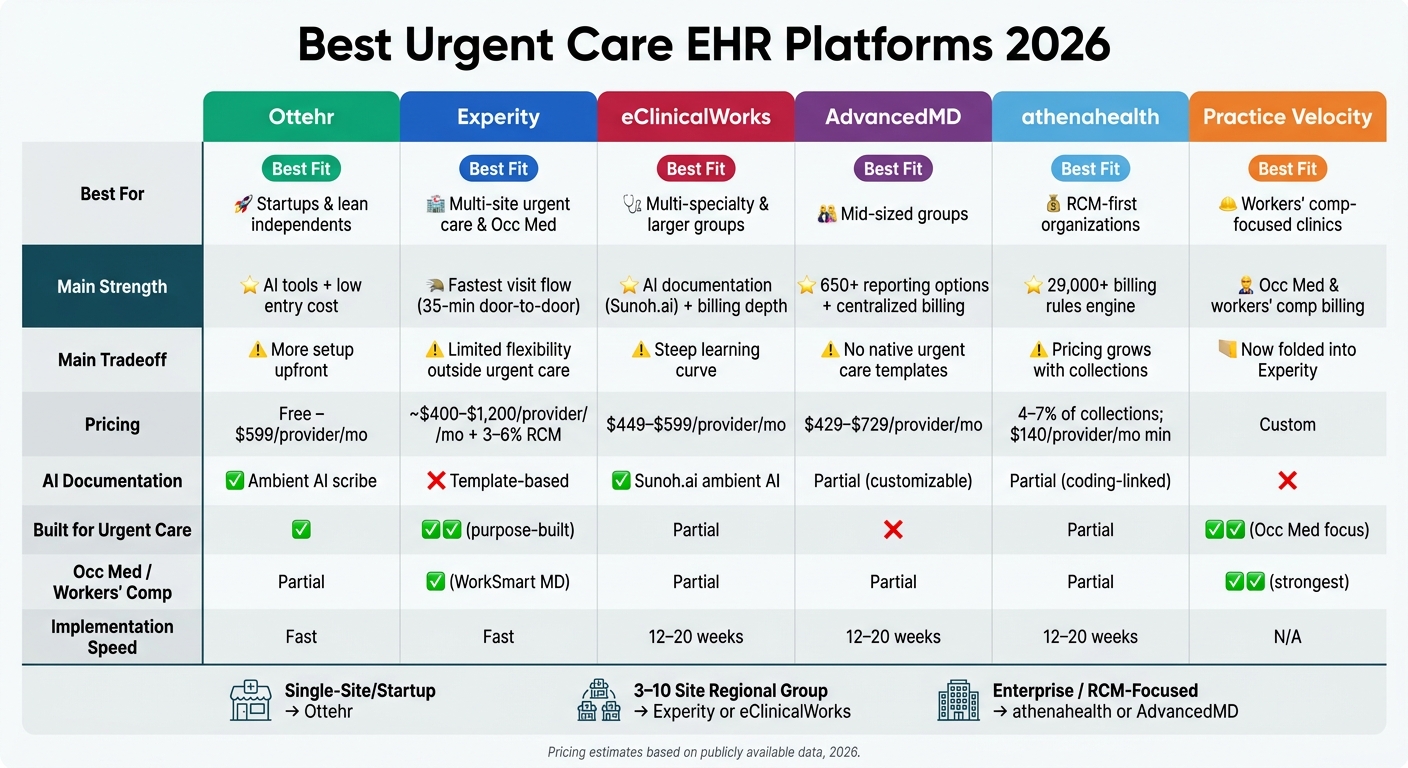
Best Urgent Care EHR 2026: Side-by-Side Platform Comparison
| Platform | Best For | Main Strength | Main Tradeoff | Public Pricing |
|---|---|---|---|---|
| Ottehr | Startups, lean independents | AI tools plus low entry cost | More setup at the start | Free to $599/provider/month |
| Experity | Multi-site urgent care, Occ Med-heavy clinics | Fast visit flow and urgent-care-first workflow | Support and reporting limits | About $400–$1,200/provider/month; RCM often 3%–6% |
| eClinicalWorks | Multi-specialty or larger groups | AI documentation and billing depth | More setup for urgent care workflows | About $449–$599/provider/month |
| AdvancedMD | Mid-sized groups | Reporting and centralized claims tools | Not built for urgent care out of the box | $429–$729/provider/month |
| athenahealth | RCM-first groups | Large billing rules engine | Cost can grow with collections | Usually 4%–7% of collections; about $140/provider/month minimum |
| Practice Velocity | Clinics focused on workers’ comp flow | Occ Med and urgent care billing logic | Now folded into Experity | Custom |
My takeaway: if you want the shortest path to urgent care workflow, I’d start with Experity and Ottehr. If your clinic is part of a larger medical group, I’d look harder at eClinicalWorks, AdvancedMD, or athenahealth. And if workers’ comp is a big share of revenue, I’d put Occ Med billing near the top of the checklist.
That framing makes the rest of the comparison a lot easier to read.
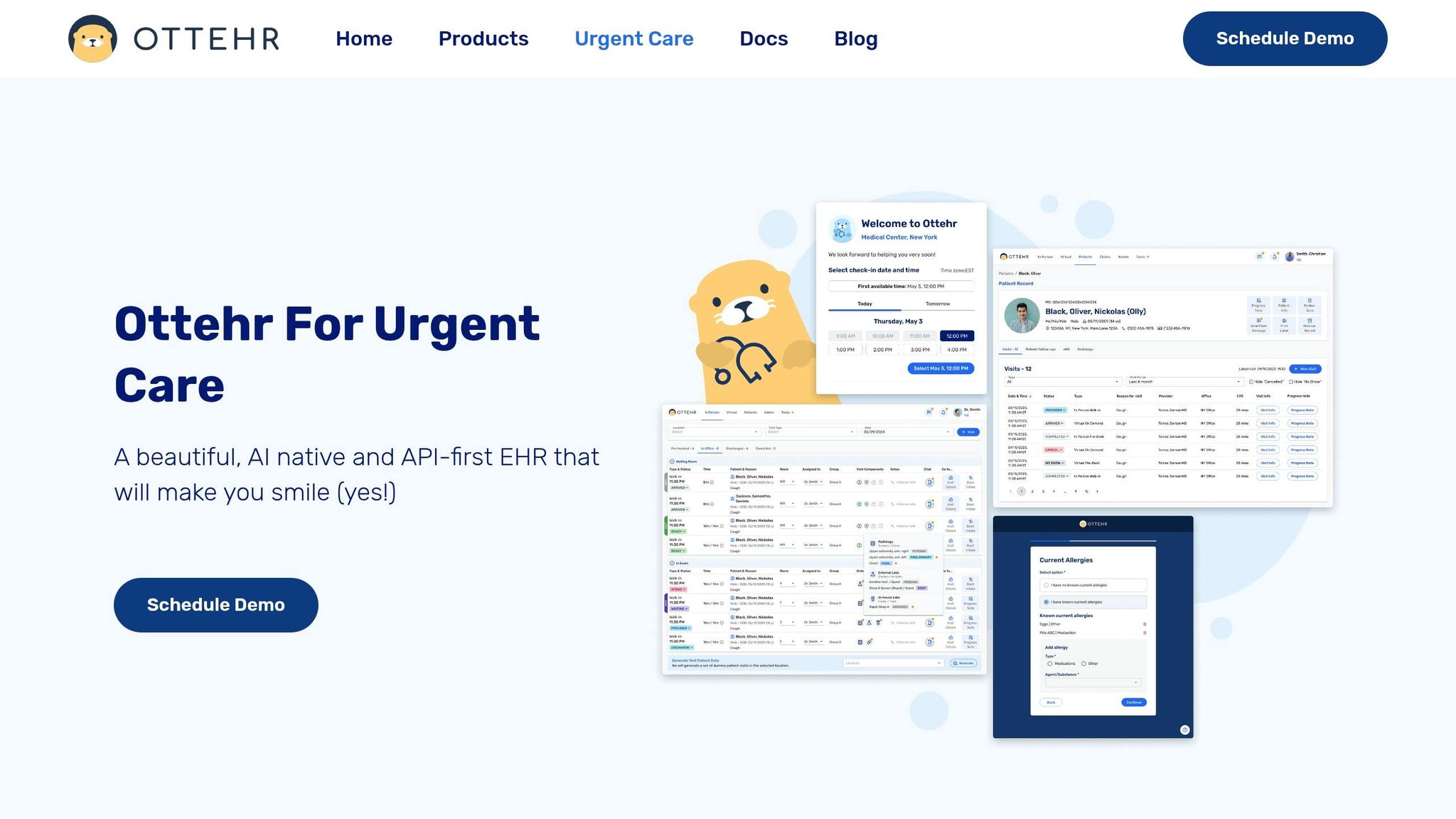
Ottehr works for urgent care, occupational medicine, and pediatric urgent care with a modular, FHIR-based workflow.
Ottehr helps keep walk-ins moving. It includes a live tracking board, pre-visit paperwork, and an AI HPI intake flow.
Patients can fill out electronic paperwork before arrival through the patient portal. An AI HPI chatbot then collects the chief complaint and history before the provider visit. SMS workflows keep patients updated on wait times, which can help cut left-without-being-seen rates. Staff can also handle walk-ins and virtual visits from the same queue.
Ottehr comes with customizable templates and an AI ambient documentation tool that builds structured notes in real time during the visit. Instead of starting with a blank page, providers review and sign the notes.
The Clinical tier includes eRx, radiology integration, orders and results, and SMS/fax. Controlled substance prescribing through EPCS is offered as an add-on for $20/provider/month.
Ottehr’s pricing is simple:
| Plan | Price | What's Included |
|---|---|---|
| Ottehr AI | Free | Tracking board, charting, AI scribe, AI HPI chatbot, telehealth |
| Ottehr Clinical | $349/provider/month | Everything in AI + custom branding and domain, customized templates, payment processing, eRx, radiology integration, SMS/fax, diagnostic orders/results, AI coding assistant |
| Ottehr RCM | $599/provider/month | Everything in Clinical + claims submission, denial management, fee schedule management, patient billing, RCM reporting |
The RCM tier adds claims submission, denial management, fee schedules, patient billing, and reporting. That means clinical tasks and revenue cycle work stay in the same workflow.
This sets the baseline for the next urgent care EHR review.
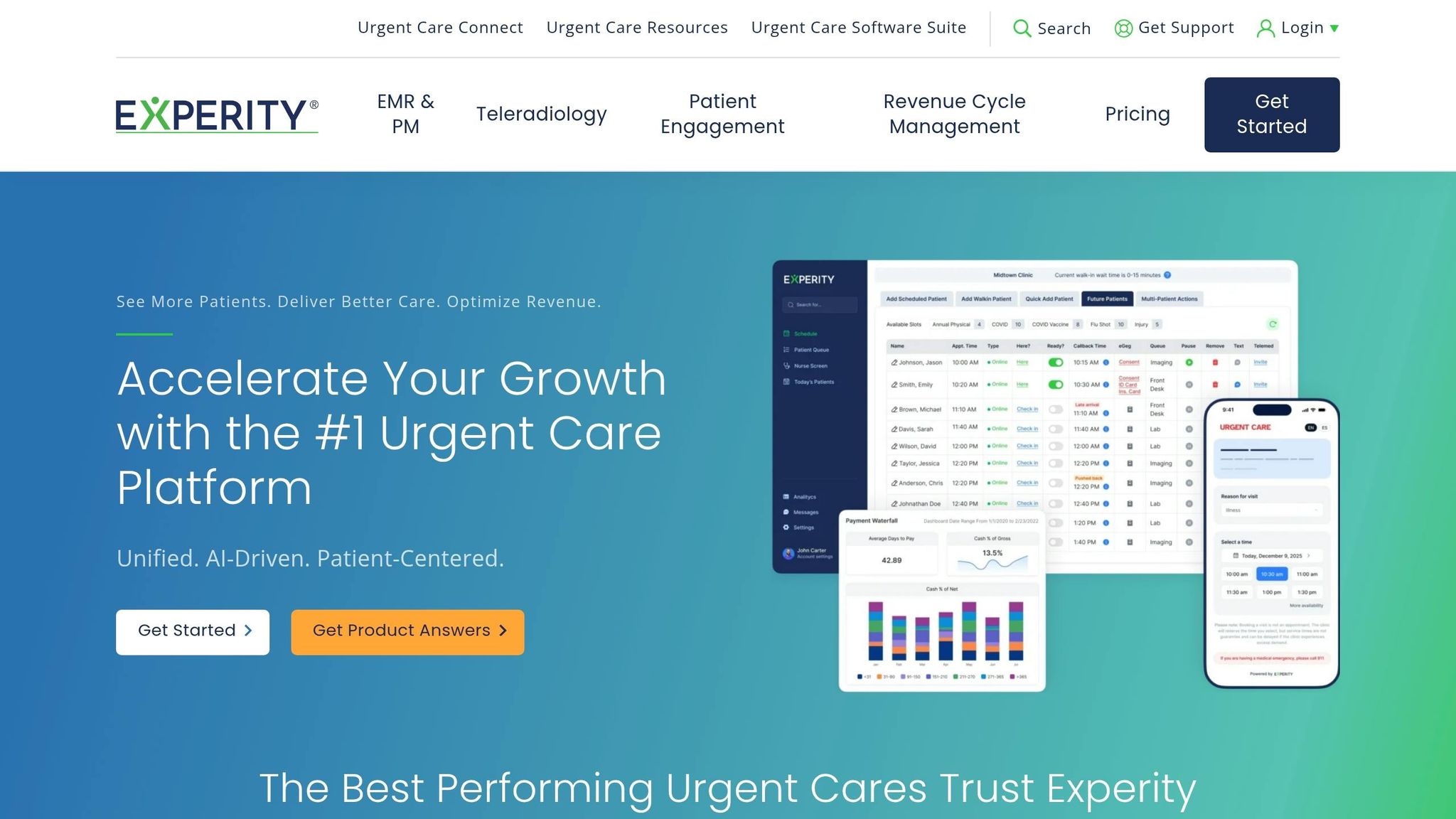
Experity powers more than 6,700 urgent care sites and is built for high-volume episodic care. If your main concern is moving patients through the clinic fast, this platform leans hard in that direction. On throughput, charting speed, and urgent care billing, Experity is designed for fast, high-volume visit flow.
Experity uses a real-time, color-coded patient tracking board so staff can see room occupancy and patient status at a glance. Online check-in runs through the integrated Clockwise.MD layer, which lets patients view live wait times and save a spot from their phones before they arrive. Insurance eligibility verification, including deductible and copay details, runs automatically at check-in. Average door-to-door time is about 35 minutes.
Its complaint-based, prebuilt templates cover common urgent care visits, and providers can chart most routine encounters in under 60 seconds. That speed comes from purpose-built templates rather than ambient AI.
"Complaint-driven logic enables providers to chart 80% of common urgent care visits in under 60 seconds." - Dr. Girirajtosh Purohit
Rapid labs such as strep, flu, COVID, and urinalysis interface directly with the EHR, and results post back into the patient chart. Digital X-ray integration sends images and teleradiology reads back into the chart as well. E-prescribing is built into the encounter workflow with automatic drug interaction checks. Lab and imaging interfaces typically cost $1,000 to $5,000 each.
Experity includes an urgent-care-aware E&M coding engine and a dedicated WorkSmart MD module for occupational medicine billing. That includes DOT physicals, drug screens, and employer-specific protocols with vendors like Quest, LabCorp, and eScreen. RCM services are typically priced at 3% to 6% of collections, with monthly subscription costs estimated between $400 and $1,200 per provider, per month, depending on the modules selected.
The trade-offs are pretty clear: slower support, occasional lag during updates or peak volume, and weaker reporting. For multi-site urgent care groups, though, the appeal is simple. They tend to value the throughput gains and urgent-care-specific billing tools.
Its speed-first design sets the benchmark for the next platforms in this comparison.
eClinicalWorks is a better fit for clinics that want broad setup options more than a ready-made urgent care workflow. It’s a feature-rich ambulatory EHR, but urgent care teams usually need to spend time tuning workflows to make it run the way they want.
Walk-in registration and occupancy boards need manual setup, which can slow implementation. That extra work may be worth it for multi-location groups or clinics that sit inside a larger multi-specialty practice. But for a standalone urgent care clinic that needs to move fast on day one, the onboarding timeline can be a real hurdle.
This is one area where eClinicalWorks has a clear edge. Its Sunoh.ai ambient documentation tool listens to natural patient-provider conversations and turns them into structured clinical notes, which cuts down a lot of manual entry. Sunoh.ai handles note creation, while Image AI sends faxes to the right chart and PRISMA pulls outside records into a single timeline.
eClinicalWorks connects with a broad network of labs, imaging providers, and pharmacies. Digital lab orders and results flow straight into the patient chart, and e-prescribing is available. That said, urgent care teams should plan for workflow setup during implementation, since these connections often need configuration work upfront.
RCM is one of eClinicalWorks’ strong points, especially for larger groups. Batch claims, denial tracking, and AI-assisted CPT and ICD suggestions help support revenue capture. Monthly subscription pricing is often cited at $449 to $599 per provider, with broader estimates running from $400 to $1,200 per provider per month depending on modules and implementation needs.
Best fit for multi-location or multi-specialty groups that want deep RCM and interoperability in one platform.
AdvancedMD is a cloud-based platform used by more than 65,000 physicians. For urgent care, the tradeoff is pretty clear: you get flexibility, but not a ready-made urgent care workflow. That shows up most in intake, charting, and billing.
AdvancedMD includes walk-in intake and tracking tools, but they’re configurable rather than built for urgent care out of the box. The shared PM/EHR setup and rooming features can cut down on manual handoffs, which helps when the front desk and clinical team are moving fast. Still, urgent care intake usually needs extra setup to fit the way the clinic runs. Implementation often takes 12 to 20 weeks.
The bigger issue tends to show up once the visit note starts.
AdvancedMD doesn’t come with built-in urgent care templates, so charting leans on customization. That can work, but it also means more setup before teams get a smooth documentation flow.
A Mobile EHR iOS app lets clinicians document away from the workstation, which can help during busy shifts. Priority task flags also make it easier to keep urgent items in view when the day gets hectic.
Billing is where AdvancedMD stands out most.
Lab, imaging, e-prescribing, EPCS, decision support, and faxing are included.
This is the part where AdvancedMD has the most pull. The platform includes:
That gives billing teams a solid view into revenue trends. Pricing starts at $429 per provider per month for practice management only and goes up to $729 per provider per month for the full EHR and PM bundle. It fits best for mid-sized groups that want tighter billing control and can handle the setup time.
Its strongest point is revenue cycle control, not a plug-and-play urgent care workflow.
athenahealth (athenaOne) is a cloud platform that brings together EHR, practice management, and patient messaging. It processes about 315 million claims each year.
Walk-in intake and tracking boards are configurable, not built in as native urgent care tools. athenaCommunicator handles online check-in through the portal, digital intake forms, and automated messaging. The platform also runs real-time eligibility checks at check-in, which can cut billing delays before the visit even begins. Implementation usually takes 12 to 20 weeks. So while the system can support walk-in care, clinics should expect more setup work than they would with software built for urgent care from day one.
That setup-heavy style also shows up in charting.
athenahealth doesn’t come with native urgent care, complaint-driven templates out of the box, so clinics need to set up workflows that fit high-volume, unscheduled visits. On the plus side, documentation ties closely to coding and billing, which helps cut manual admin work. Because it’s cloud-based and browser-accessible, providers aren’t stuck at one workstation.
Once the note is closed, the workflow moves straight into orders, results, and prescribing.
Lab results and imaging reports can flow right into patient charts through interoperability with outside labs and imaging centers. E-prescribing is built in, which helps support accurate coding and smoother visit completion.
This is where athenahealth tends to stand out. Its revenue cycle engine uses more than 29,000 billing rules to catch errors before claims go out. Those network billing rules also update when a denial happens elsewhere in the network, which helps clinics avoid the same denial again.
CenterPlace Health reported a 42% increase in visit volume and 124% growth in time-of-service collections over 12 months after putting athenaOne in place. Pricing usually falls between 4% and 7% of collections, with a minimum floor of about $140 per provider per month. That can add up fast as collections grow.
If billing performance sits at the top of your list, athenahealth makes a lot of sense. If your clinic needs a faster path to walk-in setup, though, the next platform is more urgent-care-specific.
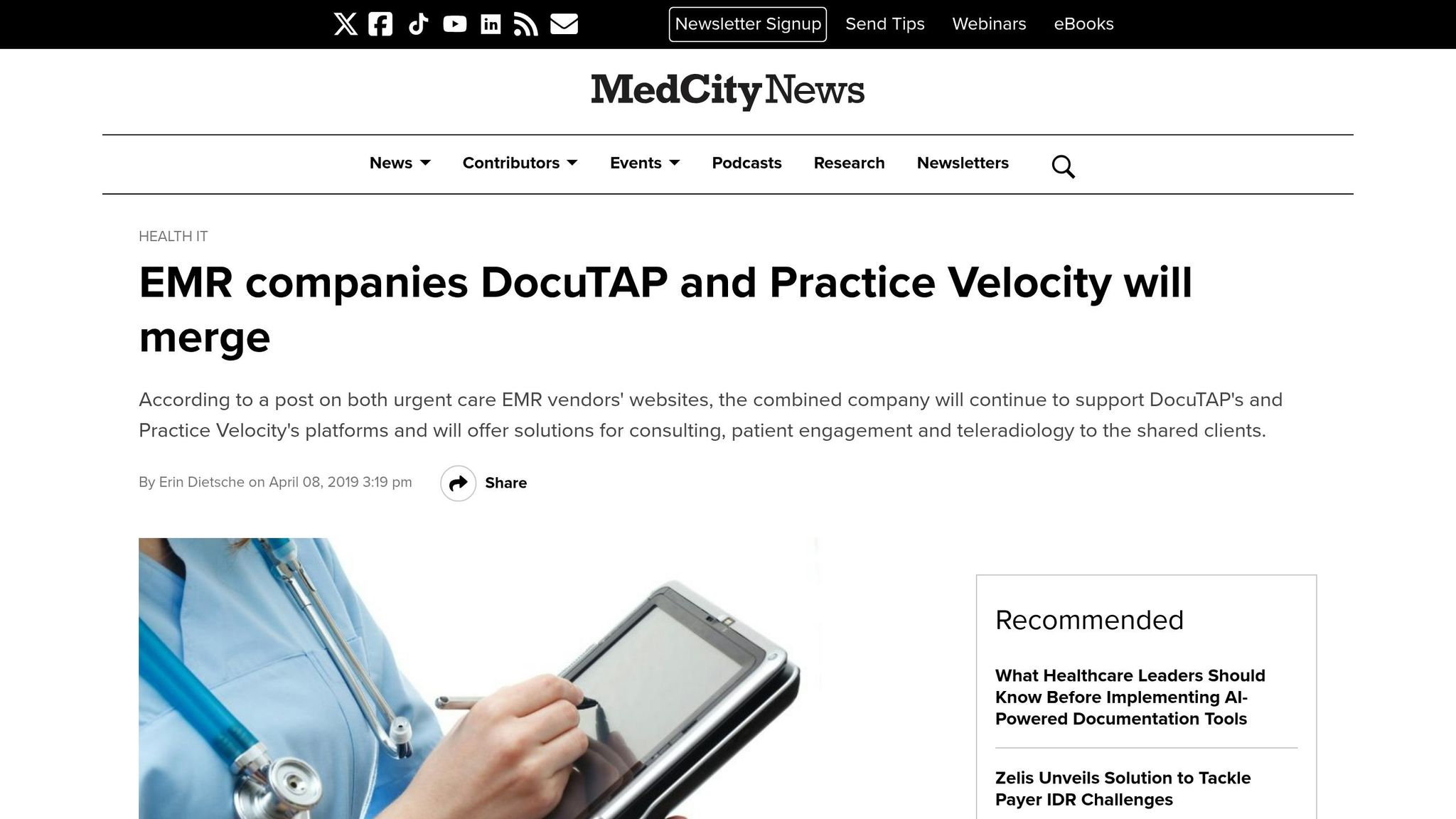
Practice Velocity became part of Experity in 2019. What still matters today is the urgent care workflow it helped shape inside the current platform.
Nurses and physicians can work in the same chart at the same time. That helps cut bottlenecks when the shift gets busy and patient volume starts piling up.
Imaging runs through an integrated PACS that sends DICOM images straight into the visit note. In plain terms, providers can review X-rays right alongside the chart instead of bouncing between systems.
The coding engine is built around urgent care E&M levels. Its strongest edge is workers' comp and occupational medicine billing, with dedicated modules for employer billing, split billing, DOT physicals, and state-specific comp rules.
No platform fits every urgent care model. The right fit depends on your clinic size, billing setup, and how much IT work your team can handle.
After looking at workflow, charting speed, imaging, and billing, one thing stands out: clinic fit is the main separator. The biggest differences show up around clinic size, occupational medicine volume, and how much control you want over billing.
| Platform | Best Fit | Main Strength | Main Limitation | Pricing Model |
|---|---|---|---|---|
| Ottehr | Startups and lean independent clinics | Low entry cost with free AI tier | Requires upfront configuration | Free to $599/provider/mo |
| Experity | Multi-site groups and Occ Med-heavy clinics | Fastest path to urgent care throughput | Limited flexibility outside urgent care | From ~$400/provider/mo; custom pricing |
| eClinicalWorks | Multi-specialty groups that can invest in configuration | Broad customization and AI documentation | Steep learning curve; not built for walk-in intake | $449–$599/provider/mo |
| AdvancedMD | Mid-sized groups where reporting and PM matter more than clinical speed | Reporting depth and centralized billing | No native urgent care templates | $429–$729/provider/mo |
| athenahealth | Revenue-cycle-focused organizations | Network billing rules at scale | Percentage-based pricing grows with collections | 4–7% of collections; $140/provider/mo minimum |
Use the table for a quick scan, then use the platform profiles below to break the tie.
The final choice comes down to the operational pain point that hits hardest. For some clinics, it's startup cost. For others, it's IT workload, Occ Med complexity, or revenue-cycle performance.
Startups and independent clinics usually need pricing they can plan around and low IT lift. In that case, it makes sense to focus on cloud-native systems with built-in RCM.
Urgent care plus occupational medicine is where platform choice can have the biggest effect on revenue. Occ Med needs native split billing, DOT physical workflows, and employer account management. If a system can't handle those well, the admin drag adds up over time.
Growing multi-site groups and revenue-cycle-focused organizations need strong reporting across locations and billing that can scale. As collection volume increases, the focus shifts toward RCM scale and interoperability.
After comparing features, the next step is simple: narrow your options based on clinic size and revenue mix.
Look at four things first: visit volume, staffing model, payer mix, and integration depth. No platform wins across all four. But the patterns are clear enough to cut your shortlist fast.
Single-site and startup clinics usually need an EHR that keeps total cost of ownership low, goes live fast, and doesn't pile extra work onto a small team. In this stage, cost and speed to launch are often the main bottlenecks.
3- to 10-site groups tend to run into a different problem. They need steady throughput across locations, and occupational medicine often starts to get more complex. If Occ Med makes up 20% or more of revenue, native workers' comp support and split-billing logic should sit in your top three buying criteria.
As your organization grows, billing control starts to matter more than basic workflow speed.
Enterprise chains should put the most weight on RCM scale and cross-site reporting.
Before you sign anything, ask for written TCO, a reference call with a customer at your scale, and proof that lab and imaging results arrive as structured data, not PDF attachments. You should also ask for a live demo built around actual urgent care workflows.
Use the summary below to line up your clinic model with the operating priorities that matter most.
| Clinic Profile | Operational Bottleneck | Key Buying Priorities |
|---|---|---|
| Single-Site / Startup | Cost and speed to launch | Low TCO, fast go-live, minimal admin overhead |
| 3–10 Site Regional Group | Throughput and Occ Med complexity | Split billing, multi-site reporting, charting speed |
| Enterprise Chain | RCM scale and reporting | Revenue capture, cross-site analytics, integration depth |
Implementation timelines vary based on practice complexity and scope, but some urgent care systems report an average of 6 to 8 weeks. In some cases, specialized AI workflow integrations or modules have gone live in 4 to 6 weeks.
Urgent care runs on speed. That’s why clinics should put streamlined, purpose-built implementation processes first to keep workflow disruption as low as possible.
The most important EHR features for faster patient flow are the ones that cut admin slowdowns and help staff document care with less friction.
That usually comes down to:
Look past the base monthly fee. Some systems use percentage-based pricing, which means your costs go up as your revenue goes up. For busy urgent care practices, that can end up costing more than a flat-rate plan.
You’ll also want to watch for extra charges tied to must-have urgent care tools, one-time setup fees, and the hidden cost of slower workflows. That last one matters more than it seems. A generic EHR that doesn’t include fast documentation templates can slow charting down and eat into staff time.

Tell us what you need and we'll get back to you soon.