
Compare three urgent care EHRs by AI features, workflow tools, and pricing to find the best fit for high-volume clinics.
Choosing the right EHR system for an urgent care center can significantly impact efficiency, patient care, and revenue management. This article evaluates three leading EHR platforms tailored for urgent care: Ottehr, Athenahealth, and NextGen Healthcare. Each offers unique features, pricing models, and tools to handle high patient volumes, fast documentation, and operational demands.
| EHR System | Best For | Key Features | Pricing |
|---|---|---|---|
| Ottehr | Customization, affordability | AI tools, FHIR-native, open-source, real-time tracking | Free base plan; $349-$599/provider |
| Athenahealth | Financial performance, AI tools | AI scribe, payer network, claim management | 4%-7% of revenue; $140 minimum |
| NextGen Healthcare | Specialty workflows, mobile use | Ambient Assist, templates, mobile app, interoperability | ~$300/provider/month |
Each platform addresses urgent care priorities like fast documentation, AI-driven tools, and efficient workflows. Continue reading for a detailed breakdown of their features, strengths, and limitations.

Urgent Care EHR Comparison: Ottehr vs Athenahealth vs NextGen Healthcare
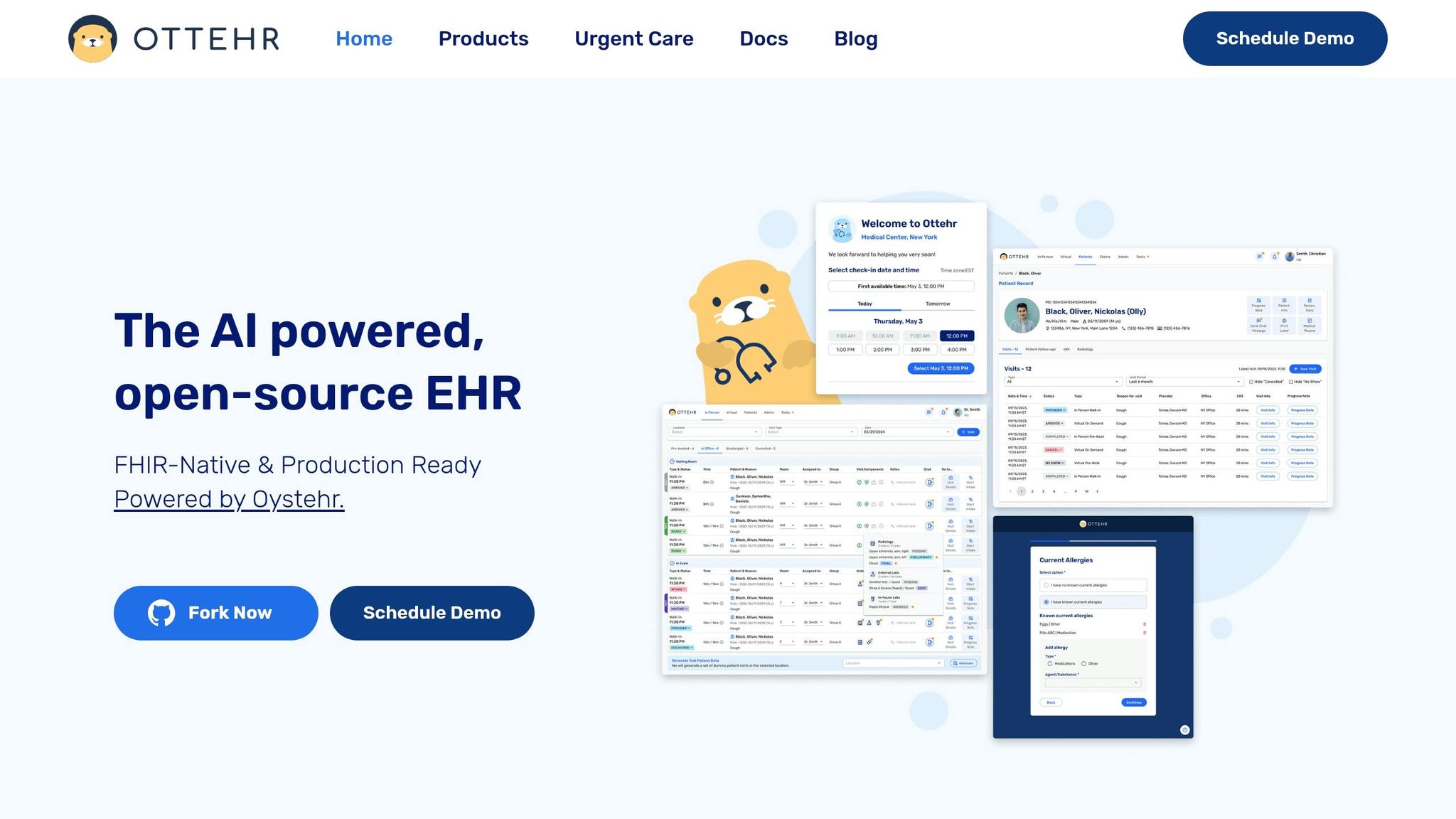
Ottehr stands out as a cutting-edge EHR solution tailored to the fast-paced needs of urgent care clinics. By combining advanced technology with a user-friendly approach, it simplifies both clinical and operational workflows.
Ottehr is recognized as the first FHIR-native EHR specifically designed for urgent care settings. Impressively, it has already managed over 1,000,000 urgent care visits and can scale to handle millions more each month. Built on an open-source foundation, it allows clinics to customize workflows without the burden of traditional licensing fees, potentially slashing the time and cost of developing a custom EHR by up to 95%. Let’s dive into the features that make Ottehr unique.
Ottehr leverages AI to improve efficiency and precision in clinical documentation. Its AI HPI and Medical History Chatbot gathers patient information about the history of present illness before the provider even steps in. During visits, the AI Ambient Scribe listens in real time, automatically documenting conversations. After the visit, the AI Coding Assistant reviews encounter data to suggest accurate billing codes, taking the guesswork out of coding.
Designed for high-volume urgent care environments, Ottehr offers tools that keep operations running smoothly. The Visits Tracking Board provides real-time updates on patient statuses, while a queuing system prioritizes patients in both virtual and in-person waiting rooms. Integrated Orders and Tasks Boards help manage diagnostics and team assignments efficiently. Native SMS and chat features ensure that all patient communication remains within the clinical workflow, minimizing disruptions.
Ottehr’s features are built with urgent care needs in mind. Its Digital Front Door simplifies patient registration and intake through SMS and chat, even before patients arrive. The system also offers integrated electronic prescribing with features like automatic pharmacy rerouting and allergy alerts. Radiology results are directly added to patient charts, and telehealth capabilities are seamlessly embedded into the workflow, ensuring smooth virtual consultations.
Ottehr offers flexible pricing to meet the needs of urgent care clinics. Its open-source core is free for practices that can manage customizations on their own. The AI tools, including the HPI chatbot, ambient scribe, tracking board, and patient portal, are also free. For $349 per provider per month, Ottehr Clinical adds features like e-prescribing, lab integrations, and the AI Coding Assistant. Clinics that need full revenue cycle management, including claims submission and patient billing, can opt for the $599 per provider per month plan.
After exploring a FHIR-native solution, let’s shift gears to an AI-powered platform. Athenahealth is a cloud-based system that combines EHR, practice management, and revenue cycle management into one unified platform. Recently, the company embraced an "AI-native" architecture, integrating artificial intelligence directly into its core workflows.
Athenahealth offers tools like athenaAmbient, a digital scribe that listens to patient-clinician conversations and drafts clinical notes, diagnoses, and prescriptions in real time. They’ve also introduced Clinically Inferred Diagnoses, a groundbreaking feature that uses AI to suggest potential diagnoses based on lab results, imaging, and vital signs. Another tool, Sage, is a generative AI assistant that answers natural language questions about a patient’s medical history. For instance, OrthoAtlanta, a healthcare provider, reported a 40% reduction in documentation time after adopting athenahealth's ambient AI technology.
"This new approach transforms the EHR into a highly effective clinical companion." - Paul Brient, Chief Product and Operations Officer, athenahealth
In fast-paced environments like urgent care, athenahealth significantly improves workflow efficiency. The AthenaOne system allows documentation to be completed in an average of 6.4 minutes per patient encounter. It also reduces charge entry delays by 43.5%–66% and achieves a 98.4% claim submission rate. Top-performing facilities using the platform can achieve patient throughput times of under 30 minutes. For example, Advanced Urgent Care, a Colorado-based practice with 11 locations and 49 physicians, saw a 51.8% increase in patient pay yield and a 26.4% reduction in billing time within a year of implementing AthenaOne.
Athenahealth offers features tailored to urgent care, such as condition-driven encounter plans, macros, and templates. The platform also connects seamlessly with labs, imaging centers, and health information exchanges, simplifying data sharing. ChartSync processes 94% of incoming medication data automatically and uses AI to summarize hospital discharge summaries, focusing on changes since the last visit. Additional tools include automated insurance card capture via OCR and predictive denial management, which flags potential claim errors before submission.
Athenahealth uses a percentage-of-collections pricing model, ranging from 4% to 7% of revenue, with a $140 minimum per provider. Implementation fees range from $2,000 to $5,000 per provider. AI features like athenaAmbient and Clinically Inferred Diagnoses are included in routine updates at no extra cost for AthenaOne users. While the platform is ideal for practices with 1 to 75 providers, the percentage-based pricing may be less cost-effective for high-revenue practices compared to flat-rate options. These pricing details emphasize Athenahealth's ability to adapt to varying practice sizes and needs.
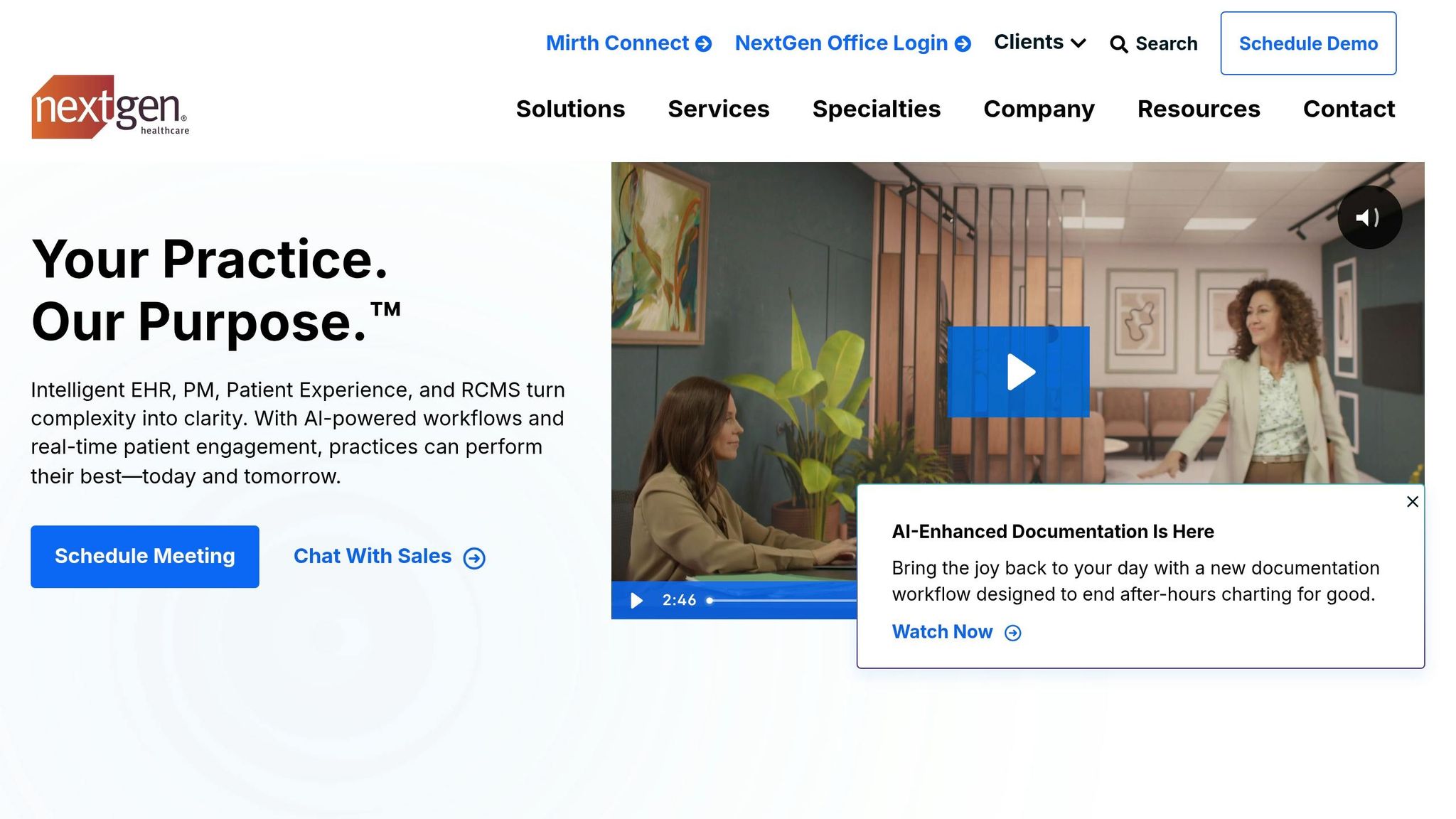
NextGen Healthcare is designed for practices that handle a mix of visit types while planning for growth. It comes with tailored blueprints for 26 medical specialties, including urgent care, and has been named the #1 EHR and Practice Management solution by Black Book Research for seven years in a row as of 2024.
NextGen's Ambient Assist technology plays a key role in streamlining documentation, handling 1.5 million patient encounters annually by converting conversations into SOAP notes on the spot. This feature helps providers save up to 2.5 hours each day on documentation, with transcription accuracy reaching around 90%. Dr. Keith M. Nord from Sports Orthopedics & Spine shared how this tool transformed his practice:
"Ambient Assist has allowed me to be more efficient in clinic. I'm able to just focus on the patient. I find I'm more mentally present. I'm not worried about taking notes." – Keith M. Nord, MD, Sports Orthopedics & Spine
Another standout feature is the AI-powered "Patient Story", which creates concise summaries of a patient’s medical history, giving providers a quick overview before appointments. During visits, the system offers real-time suggestions for ICD-10 codes, medications, and lab or imaging orders. Additionally, the NextGen Intelligent Agent - a voice- and text-activated assistant - handles tasks like schedule checks, revenue management, and retrieving patient data. Together, these tools simplify operations and improve daily workflows.
In February 2026, organizations like Juniper Health (led by CEO/CMO Dr. Derrick Hamilton) and White House Clinics (led by CMO Kathy Halcomb) reported immediate reductions in after-hours charting - or "pajama time" - after adopting NextGen Ambient Assist. Juniper Health also achieved record-high net promoter scores as providers built stronger patient relationships.
The platform’s mobile EHR extension allows providers to document visits from anywhere, with data automatically syncing to patient charts, minimizing after-hours work. Its Closed Loop Experience connects every step of the patient journey - from self-scheduling and digital intake to virtual visits and automated billing - reducing administrative strain. For financial management, NextGen uses AI to automate claims, denials, and appeals, while its Charge Review Rules Engine ensures accurate billing data before it reaches the practice management system.
NextGen offers pre-built clinical templates tailored for urgent care and episodic visits, which can be customized to fit specific practice workflows. Features like real-time patient tracking boards and integrated lab and imaging results are designed to keep up with the fast pace of urgent care settings. Its Mirth Connect Integration Engine and API Marketplace ensure smooth data sharing with hospitals, labs, imaging centers, and other systems.
The platform also supports urgent care providers through its "Success Community", a group offering solution support and educational resources tailored to this market. Dr. Charles Van Duyne, Chief Medical Information Officer at USMD Health Systems, highlighted NextGen’s collaborative approach:
"What has impressed me the most about working with NextGen Healthcare as a vendor is their commitment to working with their clients." – Charles Van Duyne, MD, Chief Medical Information Officer, USMD Health Systems
NextGen Healthcare operates on a flexible pricing model that depends on the number of providers, specialty, and chosen modules. Reports suggest the basic EHR solution starts at about $300 per month, but total costs vary based on practice size and whether the deployment is cloud-based or on-premise.
The platform is designed to serve practices of all sizes, offering NextGen Office for small practices and NextGen Enterprise for larger organizations. With support for over 250,000 providers across various specialties, it runs on Amazon Web Services (AWS), ensuring top-notch security and scalable cloud performance. Reviews on Capterra and G2 rate the platform 4.0/5, with users praising its billing capabilities and customizable templates. However, some users note a steep learning curve and occasional challenges with certain workflows.
Here's a breakdown of the key strengths and drawbacks of each EHR system, based on user feedback, performance data, and platform features.
| EHR System | Pros | Cons |
|---|---|---|
| Ottehr | • Open-source and FHIR-native: Offers workflow customization through open-source FHIR-native code • AI-powered tools: Includes a free AI HPI chatbot and ambient scribe to cut down on charting time • Transparent pricing: Features a three-tier structure starting with a free plan; clinical features cost $349/provider/month • Scalability: Successfully managed over 1 million urgent care visits |
• No mobile app: Functions mainly as a web-based platform • Customer support issues: Some users cite limited support availability • Customization challenges: Despite being open-source, customization options can feel restricted • User rating: 4.3/5 stars from 38 reviews |
| Athenahealth | • Financial performance: Boasts a 97.5% clean claim rate and a 1.6% front-end rejection rate • Extensive network: Connects over 84,000 care sites for seamless data sharing • AI assistance: Offers Sage AI assistant for chart navigation and patient data retrieval • Dedicated support: Includes an Urgent Care Customer Success Manager for performance monitoring |
• Pricing variability: Uses a percentage-of-collection model, which can make costs unpredictable • Technical hiccups: Users report unreliable dictation and inefficient faxing systems • Customization limits: Workflow personalization options are constrained • User rating: 4.1/5 stars from 179 reviews |
| NextGen Healthcare | • Specialty-focused workflows: Provides customizable templates tailored for urgent care • Efficient documentation: Ambient Assist converts conversations into clinical notes quickly • Interoperability: Offers advanced connectivity with Health Information Exchanges • Mobile-friendly: Includes a mobile app with charge capture and integrated e-prescribing |
• Steep learning curve: Advanced features can take time to master • Performance issues: Users occasionally report slow system responses • Workflow inefficiencies: Redundant data entry and complex customization processes can hinder productivity • User rating: 4.0/5 stars from 150 reviews |
Ottehr appeals to practices that want control over their EHR system with its open-source design and API-first approach. Athenahealth excels in financial management and interoperability, thanks to its high clean claim rates and extensive network connections. Meanwhile, NextGen Healthcare shines in specialty-specific workflows and mobile functionality but requires a time commitment to unlock its full potential.
These comparisons underline the distinct strengths and challenges of each platform within urgent care environments.
When selecting an EHR, it’s important to consider your practice size, workflow needs, and future growth plans. Each platform offers distinct advantages tailored to different priorities:
These platforms cater to urgent care needs with unique features, scalable pricing, and integrated AI capabilities. Ottehr emphasizes flexibility and affordability through its modular structure, Athenahealth excels in billing and interoperability, and NextGen Healthcare prioritizes specialty-specific documentation and efficient workflows.
As urgent care evolves, the right EHR should align with your current operations while supporting future advancements. Look for platforms that integrate AI-powered documentation and offer enhanced interoperability. Evaluate your options based on workflow requirements, budget, and technical needs to ensure the best fit for your practice.
To pick the right urgent care EHR, start by assessing your clinic's patient volume and workflow requirements. Look for a system that can handle a high number of patients, allows for quick documentation, and supports smooth communication between staff. If your clinic is larger, you might need features like integrated billing, while smaller clinics may value simplicity and user-friendly interfaces more. Prioritize tools that improve efficiency, like fast documentation processes and patient engagement features.
To minimize errors in notes and streamline your workflow, choose AI documentation tools that offer features like precise transcription during patient interactions, automated structured note creation, and smooth integration with EHR systems to cut down on manual data entry. Make sure the tool employs HIPAA-compliant AI models to ensure both privacy and reliability.
Switching to a new EHR system can come with several hidden costs that are easy to overlook. These might include setup fees ranging from $500 to $5,000, training expenses between $200 and $2,000, data migration costs that can fall anywhere from $500 to $3,000, and ongoing integration fees of $50 to $200 per month. It's important to factor in these potential expenses during the planning phase to prevent any unwelcome financial surprises down the line.

Tell us what you need and we'll get back to you soon.