
Cut urgent care charting time with complaint-based templates, AI notes, integrated orders, and billing-connected workflows.
If your urgent care EHR adds clicks, typing, and screen changes, patient flow slows down fast. I’d boil this down to four things that matter most: complaint-based templates, AI note help, built-in orders and eRx, and billing tied to the chart so notes can close with fewer gaps.
Here’s the short version:
A few hard facts stand out. The article says Ottehr has supported more than 1 million urgent care visits. It also says complaint-based charting can help document many common visits in under 60 seconds. That matters when a few extra clicks per visit can stack up across dozens of patients in one day.
So if I’m looking for a fast charting EHR for urgent care, I’d judge it on one test: does it help me finish the note, place orders, discharge the patient, and support clean claims without jumping across the system? That’s the core point of this piece.
Urgent care starts to drag when charting piles on extra clicks, extra screens, and manual retyping. In most clinics, that friction comes from three places: screen hopping, manual note entry, and disconnected workflows.
Many older EHRs split HPI, ROS, exam, and orders across different screens. That means staff have to bounce back and forth just to finish one visit. It doesn’t sound like much at first, but over a full day, those extra steps add up fast.
The problem gets worse when AI suggestions don’t flow straight into the note. Instead, staff have to copy and paste them by hand. That adds extra clicks and steals time from every patient visit. And when something gets missed during that process, the issue isn’t just slower charting. It can also create claim risk.
Fast visits often lead to gaps in the chart, whether that’s missing history, diagnosis details, or parts of the exam. Those omissions affect more than note quality. They can lead to downcoding and denials.
In urgent care, small misses can have an outsized effect. A skipped detail here or an incomplete note there can turn into avoidable revenue leakage, even when the clinical care itself was solid.
Things also slow down when standing orders, nurse tasks, and discharge steps sit outside the main chart workflow. Staff then have to duplicate work, track down updates, and wait for details that should already be in view.
Tracking boards help keep patient status visible so teams can move people through intake, treatment, and discharge. When those steps stay inside the visit record, the chart is easier to finish and close without extra back-and-forth.
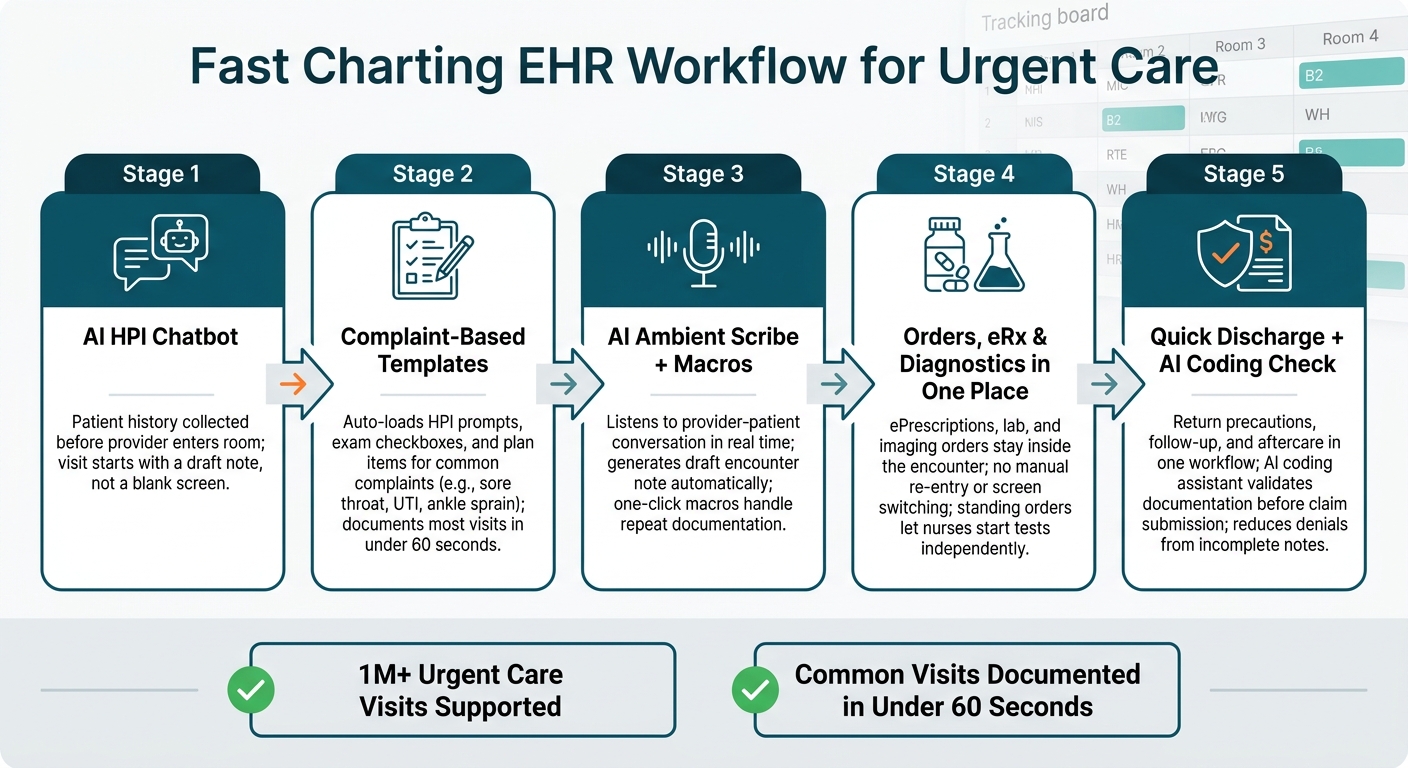
Fast Charting EHR Workflow for Urgent Care: From Intake to Clean Claim
Fast-charting EHRs cut down on screen hopping, missed details, and clunky workflows.
When a patient comes in with a sore throat, ankle sprain, or UTI, complaint-based templates pull up the right HPI prompts, exam checkboxes, and plan items right away. As the provider confirms details, structured fields populate the note.
Complaint-based charting can let providers document most common urgent care visits in under 60 seconds.
Templates make data entry faster. Structured fields help keep notes complete. And integrated order sets help with cleaner charge capture. The goal is simple: keep charting, orders, and discharge in one visit flow instead of bouncing between screens.
Macros handle repeat documentation with a short phrase or one click. Transcription tools let providers record findings while keeping their attention on the patient, not the screen.
AI-assisted note generation goes a step further. An AI ambient scribe listens to the patient-provider conversation in real time and creates a draft encounter note automatically. AI intake prompts can also collect HPI details before the visit starts, so the provider begins with a draft note instead of a blank page. That helps the note keep moving while the visit is still in progress.
When e-prescribing, lab orders, and imaging all live in the same system, staff avoid manual data entry and cut down on screen switching. And when those orders stay tied to the encounter, the chart stays more complete and charge capture gets cleaner.
Quick discharge tools keep return precautions, follow-up, and aftercare in the same workflow, which helps shorten chart closure. Next, those same time savings have to work across team workflows and billing.
Once charting gets faster, the next choke point is team coordination. Fast charting only helps when nurses, providers, billing, and the front desk stay in step. If one role falls behind, throughput slows.
Standing order protocols let nurses and MAs start common tests like strep or flu swabs in the EHR while the provider sees other patients. That keeps visits moving during busy periods and cuts down on order-entry clicks when volume is high.
Unsigned notes at the end of a shift can delay billing and drag down the next day’s workflow. A real-time tracking board shows pending results and unsigned notes, so staff can close charts before the shift ends.
When documentation flows straight into coding and claims without manual re-entry, billing teams spend less time fixing errors. Integrated billing keeps charges tied to the note, cuts manual re-entry, and shortens claim rework. Real-time insurance validation can also catch potential issues before submission instead of after.
Together, these tools speed intake, keep charts in view, and move claims forward with less rework.
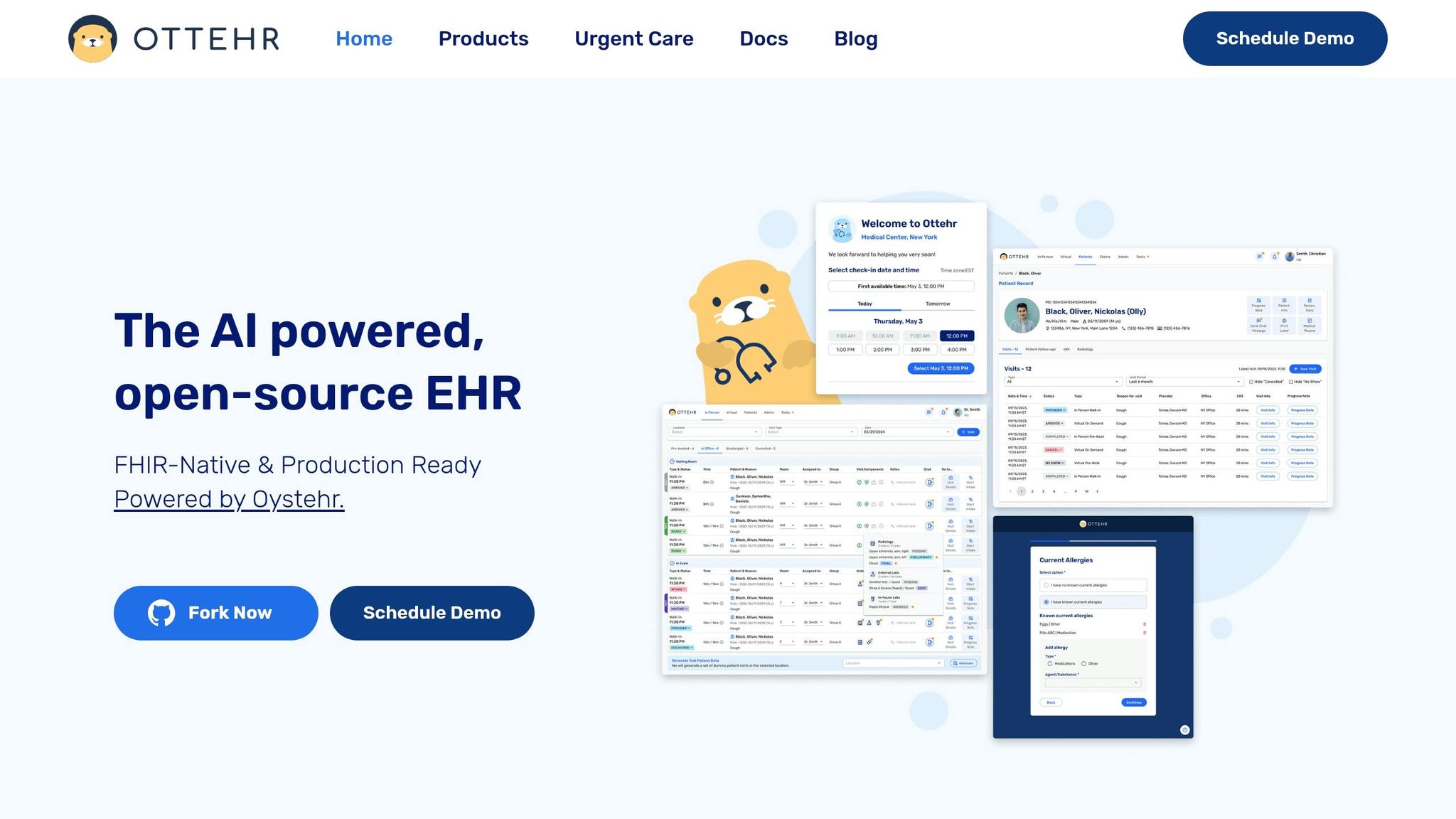
Ottehr has these urgent care workflow features built in. It’s made for urgent care teams and has supported more than 1 million urgent care visits.
Its AI HPI chatbot gathers patient history before the provider walks into the room. That means the visit starts with a draft note instead of a blank screen. During the encounter, the AI ambient scribe records visit details to cut down charting time.
Ottehr also includes templates and procedures that speed up documentation for common urgent care complaints. Exam charting and integrated assessment/plan tools help keep the note complete for billing. On top of that, the Visits Tracking Board and Tasks Board put open encounters and pending work in one place, so staff can see what still needs attention and close charts before the shift ends.
That same speed carries into orders, results, and billing.
ePrescriptions, radiology, diagnostic orders, and results stay inside the encounter, which cuts manual entry and reduces screen switching. The AI coding assistant checks that documentation lines up with billing needs before claims go out, lowering the chance of denials caused by incomplete notes.
The fastest urgent care EHR cuts friction without lowering note quality. Complaint-focused templates, AI-assisted documentation, integrated orders, and billing-connected workflows help providers close charts faster and keep claims cleaner.
Fast charting helps urgent care teams move patients through the clinic with less friction. It cuts admin slowdowns, lets providers see more patients, and helps trim wait times.
AI-powered ambient scribes and pre-visit chatbots can save up to 2.5 hours a day on documentation. That means less after-hours charting and more attention where it belongs: patient care.
Other tools help too. Customizable templates, one-click macros, automated intake, and AI-driven coding assistants can speed up charting, room turnover, and claims processing.
AI-powered ambient scribes usually save the most time because they generate clinical notes in real time during patient visits.
Other tools can also cut down documentation time, including:
Yes. Faster charting can support cleaner claims when structured documentation and AI-driven coding tools record the right clinical details in real time. That helps support medical necessity and more accurate billing codes.
Automated claim checks, real-time coding suggestions, and standardized entries can cut errors like missing diagnoses or wrong modifiers. They also help keep documentation in line with ICD-10 and CPT rules.

Tell us what you need and we'll get back to you soon.