
Open-source EMRs now rival proprietary systems with FHIR and AI features built for urgent care workflows.
Open source EMRs are a cost-effective alternative to proprietary systems, offering flexible solutions tailored to urgent care needs. They provide tools for managing patient queues, electronic prescriptions, lab integrations, and more. Key players in this space include Ottehr, OpenEMR, OpenMRS, and GNU Health, each with unique features and limitations.
| Criteria | Ottehr | OpenEMR | OpenMRS | GNU Health |
|---|---|---|---|---|
| AI Features | Native tools (scribe, chatbot) | API-integrated AI | Research-focused AI | Genetics-focused AI |
| Urgent Care Fit | Real-time tracking, telehealth | Patient flow board, triage | Configurable queues, triage | ICU and surgery modules |
| FHIR Support | Built-in (R4, R5 standards) | ONC-certified, USCDI v5 | FHIR2 Module | Read-only FHIR API |
| Cost | Free tier; paid from $349/month | Free (support costs apply) | Free (hosting costs apply) | Free (support costs apply) |
| Customization | Open-source, scalable | Developer-friendly | High flexibility | Modular design |
Each system has strengths and trade-offs, so the best choice depends on your clinic's specific needs, technical resources, and budget.
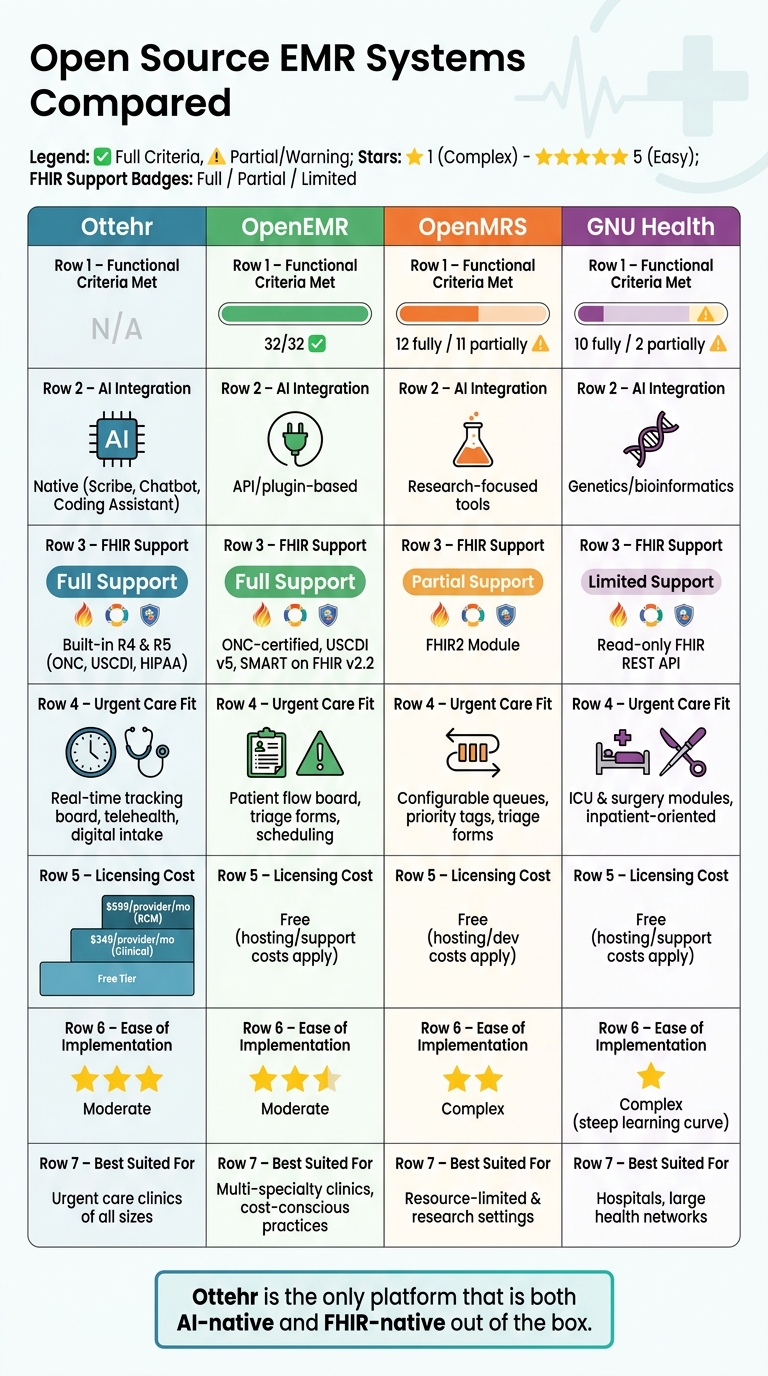
Open Source EMR Comparison: Ottehr vs OpenEMR vs OpenMRS vs GNU Health
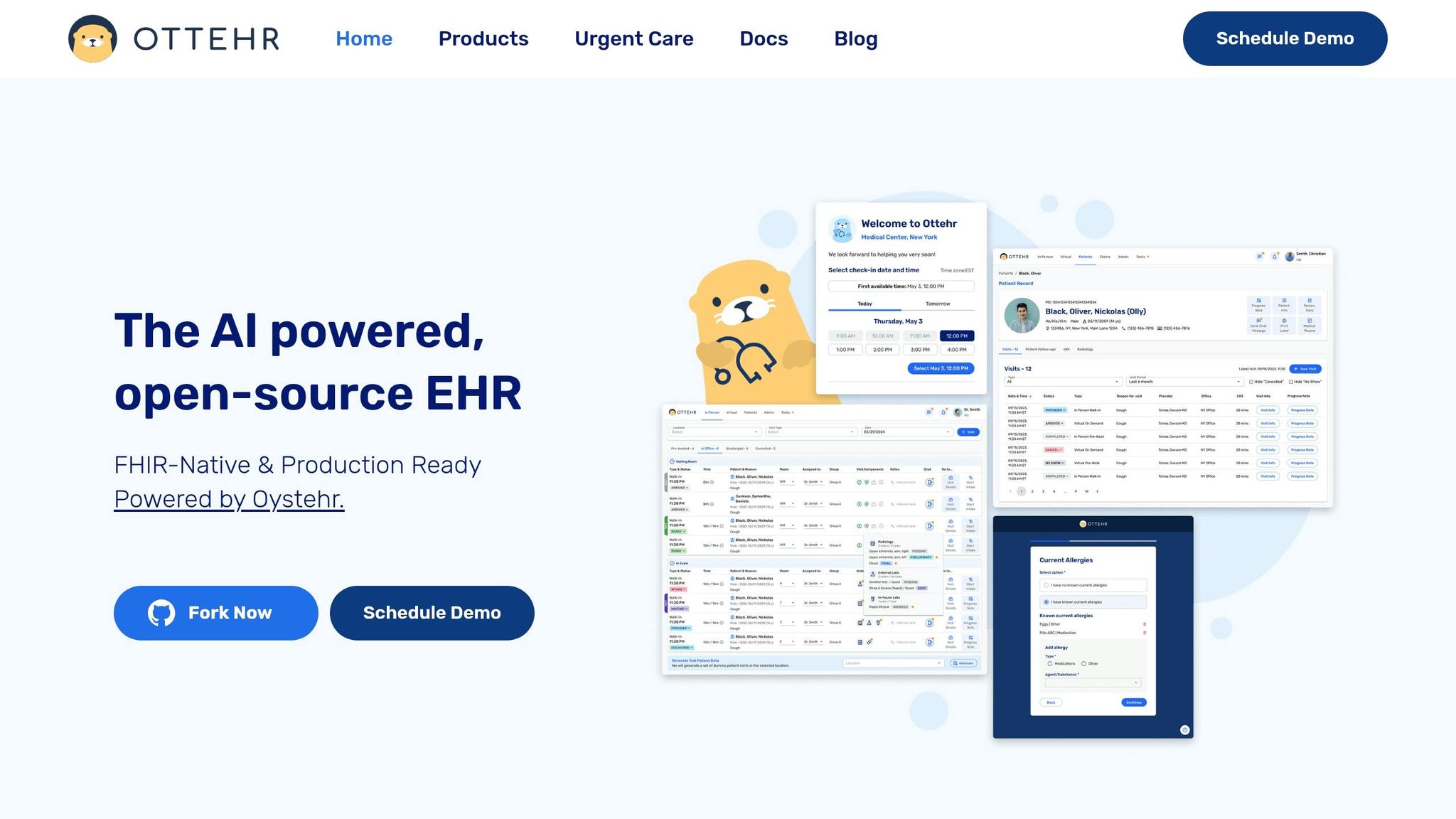
Ottehr is a FHIR-native and open-source EHR platform specifically designed for urgent care settings. Developed by experts in urgent care clinical processes and billing, it has already supported over 1 million urgent care visits. Its architecture is built to handle millions of visits monthly, making it a powerful tool for high-volume clinics. Let’s dive into how Ottehr’s features meet the unique demands of urgent care.
Ottehr provides a complete urgent care workflow right out of the box. Its tracking board offers real-time updates on patient status and manages both in-person and virtual queues. Automated digital intake simplifies patient onboarding by collecting demographics, consent forms, and insurance details before patients arrive. Telehealth functionality is seamlessly integrated, offering video visits, two-way SMS messaging, and secure chat rooms as part of the clinical workflow.
To save time and boost efficiency, Ottehr incorporates AI tools directly into its framework:
Ottehr is built on FHIR R4 and R5 standards, ensuring compliance with USCDI, ONC, X12, and HIPAA requirements. It also supports seamless Health Information Exchange (HIE) and Qualified Health Information Network (QHIN) interconnectivity. Clinics retain full local copies of their EHR data, simplifying custom reporting and analytics.
Designed with urgent care in mind, Ottehr’s open-source framework allows clinics to tailor workflows to their specific needs. Development teams can fork Ottehr’s repository to modify workflows, branding, and front-end components, cutting down on EHR development time and costs by up to 95%. For instance, PM Pediatric Care leveraged Ottehr to create a specialized pediatric urgent care EHR after years of searching for a suitable solution.
"PM Pediatric Care spent a decade looking for a great urgent-care EHR without success. OystEHR made it possible to build an open-source, no-compromises, urgent-care EHR." - Mordechai Raskas, Chief Medical Information Officer, PM Pediatric Care
Ottehr supports urgent care providers of all sizes with flexible pricing. The free tier (Ottehr AI) includes essential features like charting, telehealth, the tracking board, and AI tools. The Ottehr Clinical plan, priced at $349/provider/month, adds features like eRx, radiology integration, and custom branding. For $599/provider/month, the Ottehr RCM plan includes full revenue cycle management.
OpenEMR is a free, open-source electronic medical records (EMR) system licensed under the GNU GPL. It boasts over 4,000 monthly downloads, contributions from more than 174 developers, and is used in over 15,000 facilities, serving 90 million patients worldwide.
For walk-in clinics, OpenEMR offers tools tailored to the fast-paced urgent care environment. The Patient Flow Board tracks patient status in real time - whether they’re waiting, in a room, or with a provider - making it easier to manage unscheduled visits. The Dashboard Context Manager, introduced in version 7.0.4, includes an "Emergency" mode that simplifies the interface by focusing on critical details like vital signs and acute complaints. Additionally, clinics can create custom triage forms using the Layout Based Forms editor, a no-code tool that simplifies documentation for urgent care scenarios.
Although OpenEMR doesn’t come with a built-in AI scribe, it supports seamless integration with third-party AI tools. For instance, platforms like Keragon connect OpenEMR to OpenAI's GPT models. This allows clinics to automate tasks such as insurance verification and clinical documentation, all while maintaining HIPAA compliance and requiring no coding expertise.
Another feature is the bi-directional integration with OnPage, which sends critical notifications - like abnormal lab results or signs of clinical deterioration - directly to providers' smartphones.
"My team has replaced all individual pagers and transferred this functionality to various OnPage builds... I actually get pages more reliably." - Christopher Welch, Healthcare Practitioner
OpenEMR version 8.0.0, released in March 2026, achieved ONC Ambulatory EHR Certification and supports US Core 8.0, USCDI v5, and SMART on FHIR v2.2.0. Its FHIR API enables bulk data export through the system/*.$export endpoint and uses JWT with RS384 encryption for secure authentication, with tokens expiring after 60 seconds. These features ensure fast and secure data sharing between hospitals, labs, and public health registries, making it an excellent tool for clinics managing multi-site operations.
OpenEMR’s open-source design allows clinics to adapt the system to their specific needs. This flexibility is especially useful for urgent care centers that deal with high patient volumes and varied workflows. The Clinical Decision Rules (CDR) engine helps automate alerts based on clinical protocols, eliminating the need for developer involvement.
For larger operations, OpenEMR supports extensive patient databases and multi-location deployments. For example, Chicago Medical and Urgent Care Centers implemented OpenEMR v5 in July 2017 across several facilities, customizing workflows to include services like family medicine and physical therapy.
For teams without in-house technical expertise, professional hosting and support services are available through third-party vendors, ensuring that even non-technical clinics can benefit from OpenEMR’s capabilities.

OpenMRS is a free, open-source EMR platform that has been adopted in over 80 countries, with more than 2,200 code contributions recorded in 2025. While it has traditionally served resource-limited settings, OpenMRS is now adapting to meet the specific needs of urgent care environments.
OpenMRS offers tools tailored for managing the fast-paced nature of urgent care. Configurable queues with priority tags, color coding, and vitals tracking help streamline patient flow. Providers can define visit types like "Emergency Room Visit" or "Triage" and capture specific details such as referral sources. Using the O3 Form Builder, they can create custom triage and intake forms - all without needing to write a single line of code. For facilities with limited IT resources, HIS-Lite modules provide essential features for billing, laboratory management, and inventory tasks. Additionally, OpenMRS incorporates advanced AI tools to enhance clinical workflows and decision-making.
Built on React and TypeScript with a micro-frontend architecture, OpenMRS Version 3 (O3) makes it easy to integrate AI-powered widgets directly into its patient dashboard. One example is BirthSense OS, an AI clinical assistant that offers one-click patient history analysis and real-time drug interaction alerts. Voice-enabled tools like Medispeak further improve efficiency by allowing hands-free data entry, a game-changer for busy urgent care settings.
"Medispeak is a voice-to-text solution designed to enhance clinical workflows by enabling seamless data entry through voice commands." - Dimitri R, /dev/5, OpenMRS Community
Interoperability is another strong suit of OpenMRS. Its FHIR2 Module, maintained by the community, translates data between the FHIR standard and OpenMRS's internal model. This enables quick integration with other systems using community-developed FHIR Implementation Guides. For instance, the UW ITECH DIGI Interoperability Team successfully reduced the integration time between OpenMRS and OpenELIS from 6–8 months to just 2–3 days.
"Using FHIR IGs has sped-up our average integration time of OpenMRS with OpenELIS from 6-8 months to 2-3 days." - UW ITECH DIGI Interoperability Team
OpenMRS provides unmatched flexibility through its concept dictionary, allowing providers to define clinical observations and data schemas in detail, far beyond basic template adjustments. Role-based dashboards ensure that clinicians, front-desk staff, and other users see only the tools and data relevant to their roles. For large-scale operations, OpenMRS HIS (powered by Ozone) integrates seamlessly with Odoo for ERP, OpenELIS for lab management, and Apache Superset for data visualization, making it an excellent choice for multi-site deployments.

GNU Health brings a distinctive perspective to open source EMRs by blending clinical data with socioeconomic factors. Built on the Tryton framework and Python, and using PostgreSQL as its database, this free health ecosystem has earned recognition as a "Global Good for Health" by PATH and is featured in the Digital Public Goods Alliance registry. Its guiding principle is rooted in social medicine, aiming to create a "Book of Life" for each patient by integrating clinical information with socioeconomic determinants of health. This approach broadens the scope of care, addressing both immediate medical needs and the broader context of patient welfare.
"The GH HMIS combines the socioeconomic determinants of health with technology in bioinformatics and clinical genetics." - European Commission Interoperable Europe Portal
GNU Health includes several modules tailored for urgent care. Its ICU module supports intensive care evaluations, while the Surgery module handles pre-operative checklists and tracks procedures. Diagnostic imaging is seamlessly integrated through the Orthanc DICOM server, enabling quick access to lab results. Additionally, its decision support tools align with WHO essential medicines lists and international classification standards, including ICD-10 and ICD-11.
Rather than focusing on ambient documentation, GNU Health leverages AI for bioinformatics and clinical genetics. Its genetics module incorporates data from over 4,200 disease genes sourced from platforms like NCBI and GeneCards, while also integrating the UniProt database to analyze protein variants and their associated phenotypes. Using Python, the system processes genomic data to enhance disease identification and enable precision medicine.
GNU Health supports a FHIR REST API, covering 12 key resources such as Patient, Condition, Observation, MedicationStatement, and Immunization. While the FHIR server is read-only, allowing external systems to pull but not modify data, it ensures fast and reliable data access - essential for urgent care scenarios. For secure production deployments, TLS is mandatory, and the server is typically run with uWSGI and Nginx as a reverse proxy.
With more than 40 specialized modules, GNU Health allows urgent care facilities to install only the components they require, such as EMS, Lab, Stock, or Imaging, ensuring the system remains efficient. It also scales effortlessly, from single-board setups for remote clinics to nationwide networks using the GNU Health Federation's Thalamus API.
"The GNU Health Federation allows to build large, nation wide federated networks with thousands of heterogeneous nodes." - GNU Solidario
These features make GNU Health a versatile option for urgent care, combining flexibility with the tools needed to meet modern EMR demands efficiently.
Each system brings its own strengths and limitations. Here's a breakdown to help you choose based on your clinic's specific needs.
Ottehr is the only platform in this comparison that's both AI-native and FHIR-native. Its free tier includes tools like an ambient scribe, an AI HPI chatbot, and a real-time tracking board - features tailored for urgent care settings. Being open-source, it avoids vendor lock-in, but advanced capabilities such as ePrescriptions, radiology integration, and revenue cycle management are only available in paid plans.
OpenEMR checks all functional boxes, offering unlimited users without per-seat licensing fees. For example, HealthFirst Multi-Specialty Clinic in Pune transitioned to OpenEMR in 2025 and added two doctors without incurring extra costs. However, its user interface feels outdated, and customization often requires developer expertise.
"Switching to OpenEMR was the best business decision we made. The savings alone paid for the entire implementation, and we finally have an EMR that works the way we do." - HealthFirst Multi-Specialty Clinic
OpenMRS is well-suited for research and resource-constrained environments. Its O3 version features a modern interface built with React and TypeScript and has been implemented in over 100 Ministry facilities in Cambodia for non-communicable disease (NCD) care. Still, it fully meets only 12 out of 32 functional criteria, and its billing and practice management capabilities often need additional development.
GNU Health offers extensive hospital management features but comes with a steep learning curve. It fully satisfies just 10 functional criteria.
Here’s a side-by-side comparison of key criteria:
| Criteria | Ottehr | OpenEMR | OpenMRS | GNU Health |
|---|---|---|---|---|
| AI Integration | Native (Scribe, Chatbot, Coding) | Integrated through APIs and plugins | Integrated through research tools | Modular/custom |
| Urgent Care Fit | Tracking board, telehealth | Billing, scheduling | Requires development | Inpatient-oriented |
| Functional Criteria Met | N/A | 32/32 | 12 fully / 11 partially | 10 fully / 2 partially |
| Scalability | Multi-facility, FHIR-native | Unlimited users, multi-facility | National health networks | Large hospital systems |
| Ease of Implementation | Moderate (open-source setup) | Moderate (requires dev support) | Complex (not turnkey) | Complex (steep learning curve) |
| Licensing Cost | Free tier available; paid plans from $349/provider/mo | Free (hosting/support costs apply) | Free (hosting/dev costs apply) | Free (hosting/support costs apply) |
| Security Model | FHIR-native, cloud-ready | Rapid community patching | "4S" framework (O3) | Modular/community-driven |
This comparison underscores the importance of matching the system's features with your clinic's unique needs, particularly if you're focused on urgent care workflows.
Ottehr brings a fresh perspective to AI-driven workflows for urgent care, offering a solution that prioritizes both speed and accuracy.
Designed to meet the specific needs of your clinic, Ottehr evolves alongside your practice. Its AI-powered tools - like the ambient scribe, HPI chatbot, and coding assistant - integrate seamlessly with a real-time tracking board and a FHIR-native structure. This combination ensures smooth operations in fast-paced urgent care environments. Built on FHIR R4 and R5 standards, Ottehr complies with USCDI, ONC, X12, and HIPAA guidelines. Plus, its open-source EHR framework eliminates vendor lock-in while slashing EHR development costs by up to 95%.
The free tier includes essential features such as charting, telehealth, AI scribing, and the tracking board, providing immediate value to urgent care providers. For clinics seeking more advanced capabilities, Ottehr offers scalable plans with features like ePrescriptions and full revenue cycle management, ensuring cost-effective solutions as your needs expand.
Discover how Ottehr can enhance patient care and streamline your clinic's workflow.
Implementing an open-source EMR in a U.S. urgent care setting involves several considerations, such as the size of the practice, current infrastructure, and the level of customization required. Open-source systems like OpenEMR and others offer flexibility and configurability, but their setup demands technical know-how. Key steps include installing the software, integrating it with existing systems, and ensuring compliance with healthcare regulations.
Additionally, practices need to focus on data migration, adjusting workflows to fit the new system, training staff to use the platform effectively, and ongoing system maintenance. The complexity of the process largely depends on the practice’s available resources and specific objectives.
Before launching an open-source EMR system, it's critical to ensure it complies with HIPAA, ONC, and FHIR standards. Here's what to check:
These steps help safeguard sensitive data and maintain compliance with industry regulations.
When budgeting for software, remember that the license fee is just the beginning. You'll also need to account for support and maintenance costs, which often range from $100 to $500 per user each month. On top of that, there are expenses for hardware upgrades, data storage, security measures, and system updates.
Don’t overlook staff training, which typically adds up to 15–20% of the initial implementation costs annually. If you plan to integrate third-party systems like billing or lab services, additional fees may apply. All these factors contribute to the total cost of ownership, making it much more than just the price of the software itself.

Tell us what you need and we'll get back to you soon.