
AI, FHIR interoperability, and automated billing streamline urgent care EHRs, cutting documentation time and reducing claim denials.
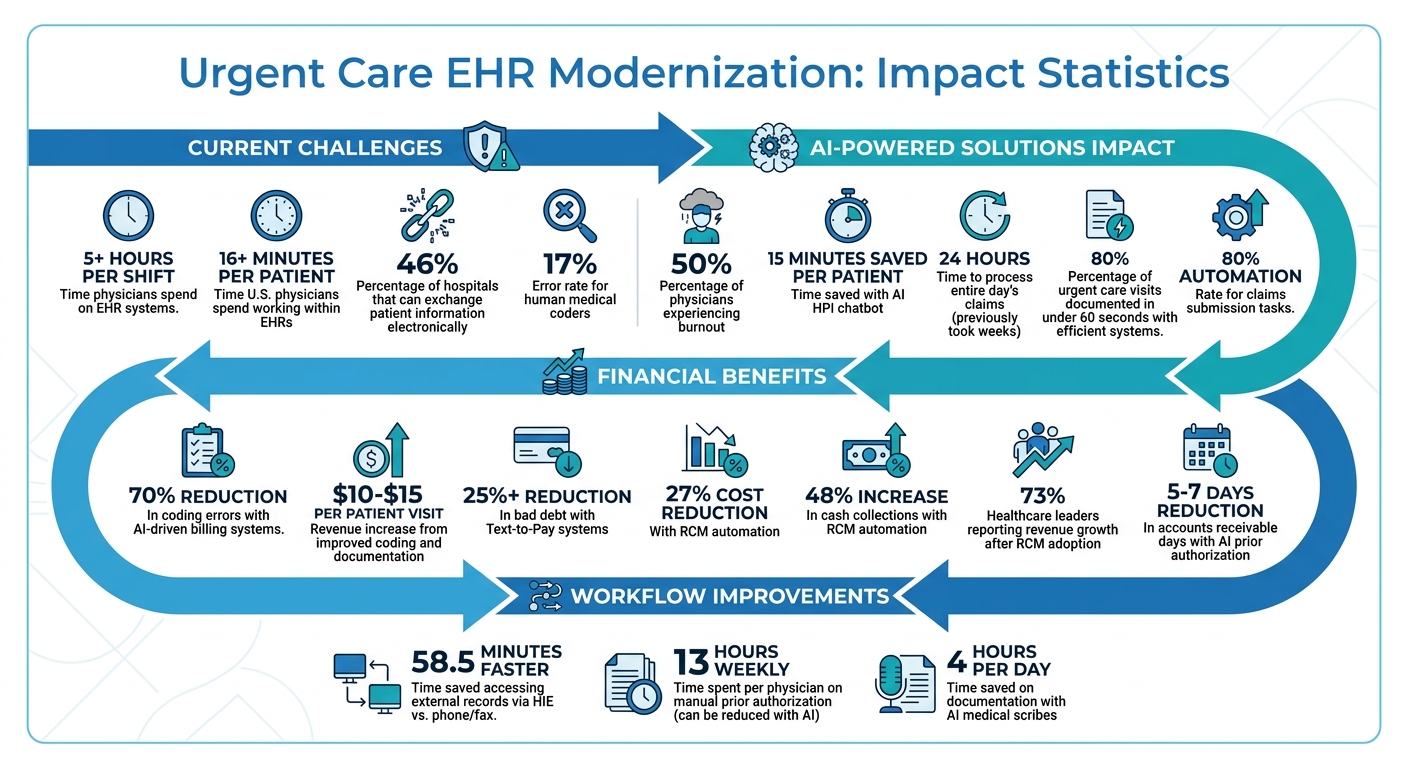
Urgent care centers are struggling with outdated EHR systems that waste time, contribute to provider burnout, and hurt financial performance. Physicians spend over 5 hours per shift on these systems, dealing with clunky interfaces, irrelevant alerts, and isolated data silos. These inefficiencies also slow billing processes and increase claim denials.
Key solutions include:
Urgent Care EHR Modernization: Key Statistics and ROI Impact
The urgent care industry is undergoing a major transformation, driven by advancements in artificial intelligence (AI), improved data exchange, and automated financial workflows. These technologies are helping to address common challenges like fragmented data systems, slow reimbursement processes, and inefficiencies in daily operations.
AI is reshaping how urgent care centers handle clinical and administrative tasks. Tools like ambient scribes now automatically generate clinical notes during patient visits, while coding assistants recommend accurate ICD, CPT, and E/M codes. This not only reduces the time spent on post-visit charting but also ensures better compliance.
Lohith Reddy, Executive Vice President at Exdion Health, highlights the impact: "Claims that took weeks to process can now be edited and submitted in days". AI-powered systems can process an entire day's claims within 24 hours - a task that previously took weeks when done manually. These tools also provide real-time feedback to clinicians, such as suggesting higher E/M levels when documentation supports it or flagging issues that might trigger audits before claims are submitted.
AI's role goes beyond documentation. AI-driven patient engagement tools streamline scheduling, insurance verification, and lab result delivery through secure text or web platforms. This helps reduce the workload on front-desk staff and improves the overall patient experience. Additionally, predictive analytics are being used to forecast patient demand, enabling facilities to plan staffing and resources based on historical trends.
These advancements in AI are laying the groundwork for improved data exchange, which is explored in the next section.
Although connected healthcare holds great promise, only 46% of hospitals can currently exchange patient information electronically with external providers. To bridge this gap, modern EHR systems are leveraging AI-driven semantic interoperability to translate medical terminologies across platforms.
FHIR standards (Fast Healthcare Interoperability Resources) are enabling real-time data sharing. For example, FHIR-compliant systems can automatically reconcile medication lists during patient transfers. Generative AI further simplifies patient handoffs by summarizing discharge instructions and follow-up plans, ensuring no critical details are overlooked.
Another innovation is real-time voice AI integration. These systems capture clinical data from phone calls or telehealth sessions and route it directly into EHRs through secure APIs. This is especially valuable since U.S. physicians spend over 16 minutes per patient working within EHRs. Automating data capture reduces this administrative burden while maintaining HIPAA compliance through encrypted credentials and access tokens. Enhanced data exchange not only improves clinical workflows but also strengthens financial processes, which are discussed next.
The combination of better documentation and interoperability has paved the way for automated billing systems that streamline financial workflows. For instance, AI-powered insurance matching uses OCR (optical character recognition) to extract data from driver's licenses and insurance cards during digital check-ins. This ensures patients are matched to the correct payer, reducing eligibility errors that often lead to claim denials.
Human coders can have error rates as high as 17%, but AI-driven billing systems can cut these errors by up to 70%. This accuracy translates to a tangible financial impact: improved coding and documentation can increase revenue by $10 to $15 per patient visit. Automated billing tools, such as "Text-to-Pay" systems, also help reduce bad debt by more than 25%.
Real-time eligibility checks, automated claim scrubbing, and centralized accounts receivable management further accelerate the revenue cycle. These systems track claim statuses and categorize denials, enabling quicker appeals and ensuring smoother financial operations for urgent care facilities.
Urgent care facilities handle high patient volumes and diverse clinical situations, so their EHR systems must be equipped with tools that simplify documentation without compromising accuracy. By integrating modern AI capabilities and prioritizing interoperability, these features help urgent care EHRs balance efficiency with precision.
SOAP note templates tailored to urgent care workflows are a must-have. Features like voice dictation can speed up charting, allowing providers to keep up with the fast-paced environment of urgent care visits.
Clinicians using customized EHR systems report nearly double the satisfaction compared to those without such tools. In fact, providers with specialty-aligned workflows experience satisfaction rates that are 25 times higher. Many platforms now include "Clinical Content Builders" with drag-and-drop functionality, enabling real-time updates to forms and workflows. These advancements reflect the benefits of AI-enhanced documentation tools.
"Usability is key in urgent care, allowing providers to document patient interactions smoothly, improving workflow, and reducing frustration." – Oystehr
Digital check-ins that can be tailored to specific needs replace traditional paperwork, streamlining the patient intake process. These customizable forms are particularly useful for capturing specialized data, such as information for Occupational Medicine or Workers' Compensation cases, ensuring only relevant fields are displayed during registration. OCR technology adds another layer of efficiency by extracting data from driver's licenses and insurance cards, minimizing manual errors.
"I intake around 70 patients a day. With this EMR system, my job has become a breeze. It's straightforward and intuitive, allowing me to efficiently gather patient information, collect payments and schedule patients."
These forms also enable real-time insurance verification and automated eligibility checks, reducing claim denials and easing administrative workloads.
Urgent care visits often involve patients presenting with multiple issues, making advanced documentation tools essential. These systems must address scenarios where discrepancies arise between nursing triage notes and physician documentation - like a nurse recording "chest pain" while the physician notes "epigastric pain". Such inconsistencies are a common factor in malpractice settlements. Modern EHRs can prompt providers to resolve these conflicts before finalizing the visit.
"A discrepancy may be nothing more than a minor difference in terminology; but... [it can] reveal serious discrepancies between the physician and the nurse chart." – The Sullivan Group
Efficient complaint-driven systems allow providers to document 80% of urgent care visits in under 60 seconds. While these tools enhance speed, they also ensure accuracy by prompting providers to verify auto-filled data for each encounter. This reduces the risk of outdated information compromising patient safety or legal defensibility.
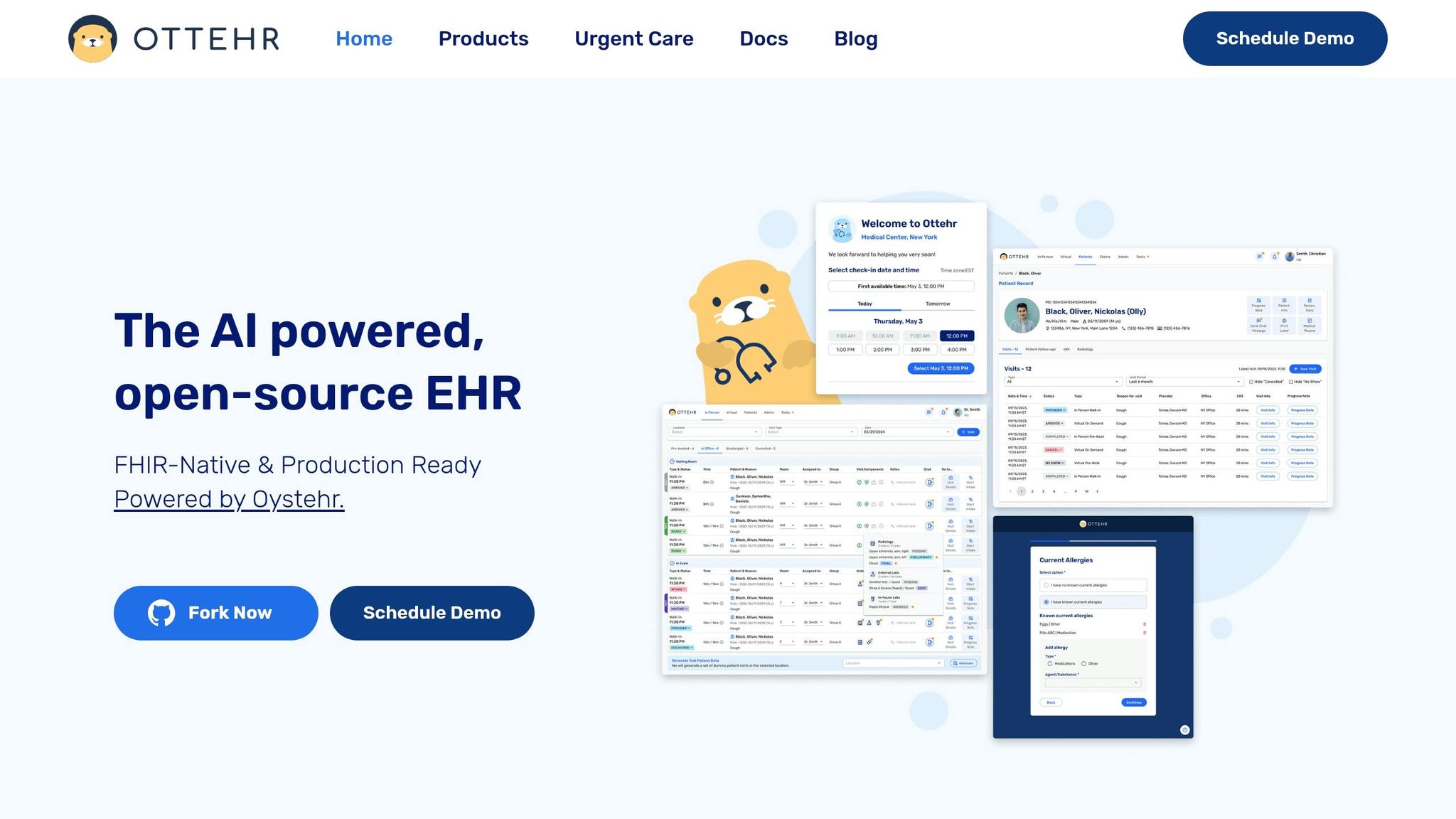
Ottehr is reshaping urgent care by addressing operational inefficiencies and financial challenges with its AI-driven tools and FHIR-native and open-source EHR platform. With over a million urgent care visits under its belt, the platform offers solutions that cut down on documentation time, enhance coding accuracy, and streamline revenue processes. Its free AI package and flexible pricing tiers make it a practical choice for high-volume workflows.
Ottehr's AI-powered tools simplify patient interactions and documentation. The AI HPI and Medical History Chatbot automates patient interviews, gathering HPI and medical history data before the provider even steps in. This process can save up to 15 minutes per patient, giving clinicians more time to focus on care rather than paperwork. Additionally, the AI Ambient Scribe listens in during visits, capturing conversations and generating encounter documentation, transcriptions, and summaries in real time. These tools not only reduce the administrative workload that contributes to burnout - an issue affecting nearly 50% of physicians - but also help providers maintain patient engagement by eliminating the need to multitask during appointments.
The AI Coding Assistant ensures precise coding by suggesting appropriate codes based on encounter documentation, minimizing errors and streamlining patient management. Meanwhile, the ePrescription (eRx) module enhances medication safety by syncing patient medication and allergy history, alerting providers to potential drug interactions or allergies. If a prescribed medication is unavailable, the module can automatically reroute and suggest alternatives. These tools are part of the Ottehr Clinical plan, priced at $349 per provider per month, with an optional EPCS add-on for $20 per provider per month.
Ottehr's Revenue Cycle Management (RCM) suite, designed by urgent care specialists, automates key financial processes. Through integration with Change Healthcare, it verifies insurance eligibility in real time. The claims validation service flags errors before submission, reducing denials and saving time. By automating up to 80% of claims submission tasks, this solution can lower costs by 27% and increase cash collections by as much as 48%. Notably, 73% of healthcare leaders have reported revenue growth after adopting RCM automation. The RCM plan is priced at $599 per provider per month and includes features like claims submission, denial management, fee schedules, charge masters, detailed reporting, and patient billing. Integrated payment processing is available at 2.9% + $0.30 per transaction.
"Our new behavioral health intake application, built on OystEHR, allowed us to build a solution that is customized for our use including scheduling, insurance validation, and direct integration with our eClinicalWorks EHR." – Mordechai Raskas, Chief Medical Information Officer, PM Pediatric Care
These tools are paving the way for further advancements in EHR systems, making urgent care operations more efficient and patient-focused.
Modernizing your urgent care EHR isn’t just about upgrading software - it’s about rethinking how your practice operates as a whole. From assessing workflows to training your team on AI tools and tracking financial outcomes, a structured approach ensures your efforts lead to better efficiency and patient care - not just a flashier system.
Start by mapping out every clinical task, from patient check-in to billing. This helps identify bottlenecks and areas where EHR customization can make a real difference. For example, tailored SOAP note templates or interface shortcuts can streamline operations significantly. Optimized workflows are essential to leveraging AI in urgent care.
Routine visits, like pediatric check-ups or follow-ups, benefit from pre-built templates that save time and ensure consistency across records. Look for EHR systems that allow you to tweak interfaces - adjusting forms, screens, and text fields to fit specific clinical needs. The aim is to cut down on unnecessary clicks and reduce task-switching, which research shows can actually cancel out time savings.
"Selecting the right EHR for your urgent care clinic is a serious decision. EHR impacts every aspect of your urgent care practice from scheduling to clinical notes and medical billing." – DrChrono Blog
Integration is another key factor. Systems with bi-directional APIs can connect seamlessly with labs, imaging centers, and billing software, reducing manual data entry and speeding up diagnoses. Health information exchange (HIE) capabilities also allow providers to access external records faster - on average, 58.5 minutes quicker than manual phone or fax requests - helping to avoid unnecessary imaging or hospital admissions. When evaluating vendors, use a checklist that covers essentials like e-prescribing (eRx), EPCS certification, real-time insurance eligibility checks, and integrated lab ordering.
Once workflows are optimized, it’s time to focus on equipping your team to use these tools effectively.
Proper training is what turns AI tools into productivity boosters. The key idea? AI should reassign tasks, not replace people. Staff currently responsible for manual tasks like faxing or data entry should be trained to handle exceptions or escalations instead.
Training should take place within your actual EHR environment - not a demo system. Adoption often fails when staff must step outside their usual workflows to use AI tools. Show your team how AI features like ambient scribes, HPI chatbots, and coding assistants fit into their daily routines. For instance, AI medical scribes can save providers up to four hours a day on documentation. Demonstrating these savings with real patient scenarios during training can boost buy-in.
Prepare your team for the AI learning curve. Models may struggle with regional dialects, medical slang, or complex terminology, so staff should know when to intervene. Instead of manually entering data, train them to review AI outputs. While human medical coders have error rates as high as 17%, AI can reduce these errors by up to 70%. Plan for a 4- to 12-week implementation period to ensure smooth integration and adjustment.
"The clinics getting ahead in 2026 aren't the ones with the most sophisticated AI. They're the ones who picked a tool that fits their actual workflow, integrated it cleanly with their EHR, and trained their staff to use it well." – OmniMD
Tailored, role-specific training is also critical. Nurses and administrative staff need programs designed for their responsibilities to reduce frustration and improve adoption. Involving clinicians in vendor selection and workflow design early on can further increase buy-in and ensure the system meets daily needs.
Once your team is proficient with the tools, tracking performance metrics will help you measure the success of your modernization efforts.
Set baseline metrics (like visit length, chart close rates, and claims denials) and use real-time dashboards to track improvements in clinical and financial performance. Modern EHR systems often come with reporting tools that measure key indicators such as readmission rates, length of stay, and mortality rates. These metrics validate whether your EHR modernization is delivering on its promises.
Financial tracking should also happen in real time. Look for systems that provide insurance eligibility checks and tools for analyzing reimbursements and denials to keep your revenue cycle strong.
AI-powered prior authorization tools can deliver measurable results. On average, practices spend 13 hours weekly per physician on manual prior authorization requests, but AI can reduce accounts receivable days by 5 to 7. With the CMS Interoperability and Prior Authorization Final Rule (CMS-0057-F) taking effect on January 1, 2026, clinics must comply with new decision timelines - 7 days for standard requests and 72 hours for expedited ones - making AI adoption increasingly important.
Dashboards displaying both clinical and operational metrics can highlight where AI tools are saving time and where bottlenecks persist. This data-driven approach turns modernization into an ongoing process of improvement rather than a one-time upgrade.
Upgrading your urgent care EHR isn't just a tech update - it's a strategic move to enhance patient care and stay competitive in a fast-paced industry. With AI-powered documentation, automated coding, and real-time financial tools, you can tackle persistent challenges like provider fatigue, billing mistakes, and sluggish patient flow head-on.
Think of EHR modernization as more than just a software change - it's a chance to reimagine your operations. AI-driven ambient scribes can free up providers' time, automated coding tools can cut down on errors, and integrated systems can simplify your revenue cycle. These updates have the potential to transform how your practice operates at every level.
"Speed is a significant factor in urgent care clinics, where delays can have dire consequences." – Amazing Charts
To make these changes stick, focus on seamless integration with your current workflows. Real-time analytics dashboards can give you instant insights into patient flow and financial health, helping you pivot quickly when needed. Tools like teleradiology and e-prescribing eliminate unnecessary steps, speeding up care delivery while maintaining safety.
Start by assessing your workflows, equipping your team with targeted training, and tracking ROI in real time. The most successful practices focus on reducing provider burnout, improving patient flow, and ensuring top-notch security throughout the process. When done right, your EHR can shift from being a source of frustration to a powerful tool that sets your practice apart.
The quickest path to upgrading an urgent care EHR is by choosing a system that's easy to use, quick to implement, and minimizes workflow interruptions. Look for solutions that streamline tasks like patient registration, enable fast charting, and work effortlessly with your current processes. Opting for platforms with flexible customization and a short learning curve helps ensure a smooth transition without sacrificing the clinic's productivity.
AI tools help streamline provider charting by automating documentation and improving accuracy. They capture patient conversations and convert them into structured notes, saving providers around 9–13 minutes per patient encounter. These tools are designed to align with regulatory standards, offering features like automated validation and real-time transcription to ensure compliance. By handling these tasks, AI allows providers to dedicate more time to patient care while still meeting documentation requirements effectively.
An urgent care EHR needs to have interoperability features such as support for FHIR-based APIs, real-time data exchange, and seamless connections with external providers and organizations. These tools make it easier to transfer results, track patient trends, and improve coordination, leading to more efficient and effective care delivery.

Tell us what you need and we'll get back to you soon.