
Urgent care solutions to cut denials, speed collections, and fix registration, coding, and staffing with AI and better workflows.
Urgent care centers face unique revenue cycle management (RCM) challenges that can impact financial health. From insurance verification errors to claim denials and understaffed billing teams, these issues lead to lost revenue, delays, and inefficiencies. The article highlights key problems and offers actionable solutions, including the use of AI tools, better front-end processes, and denial tracking to improve cash flow and reduce errors.
By integrating technology and improving workflows, urgent care centers can address these challenges and maintain financial stability.
Urgent care centers face a fast-paced environment where walk-in patients, high volumes, and quick turnaround times often lead to revenue leaks. Tackling these challenges requires a clear understanding of where issues arise - whether at the front desk, in documentation, or during claims processing. Each step in the revenue cycle presents unique hurdles that, if left unchecked, can significantly impact financial performance.
The front desk is often the starting point for revenue cycle issues. Rushed registrations can lead to incomplete or incorrect patient data, such as wrong names, dates of birth, or addresses, which result in immediate claim rejections. Failing to verify insurance coverage or selecting the wrong payer or plan type (e.g., confusing an HMO with a PPO) can lead to denied claims. For centers that frequently treat out-of-network patients, these errors create disputes and increase the likelihood of unpaid balances.
The numbers tell the story: 15% of medical claims are initially denied, and resolving each denial costs an average of $118. In 2022 alone, U.S. hospitals and health systems spent $19.7 billion addressing denied claims.
| Common Registration Error | Impact on Revenue Cycle |
|---|---|
| Incorrect Patient Name/DOB | Immediate claim rejection |
| Expired Insurance Coverage | Shifts balance to self-pay |
| Wrong Payer/Plan Selection | Payment delays or denials |
| Failure to Collect Copay | Increased risk of bad debt |
| Missing Prior Authorization | Claim denial; hard to appeal later |
Real-time insurance verification tools integrated into EHR systems can instantly confirm coverage during registration. Additionally, using standardized checklists ensures that patient demographics, insurance details, and plan types are double-checked before the patient leaves. Collecting copays and deductibles upfront also reduces reliance on costly and inefficient back-end collections.
The urgency of care delivery often leaves little time for accurate documentation, increasing the risk of coding mistakes. With frequent updates to CPT, ICD-10, and HCPCS codes, even small errors - like incorrect modifiers - can lead to rejections. In fact, 35% of claim denials are due to coding mistakes.
Another common issue is medical necessity gaps. If clinical documentation doesn’t clearly support the services billed, payers will deny the claim outright. Modifier misuse, such as improper application of -25 or -59, is also a frequent problem in urgent care settings.
"Incomplete documentation results in downcoding, denials, or audits." - Right Medical Billing
Undercoding or downcoding, where services are billed at a lower level due to incomplete documentation, results in lost revenue. With urgent care centers seeing an average of 350 patients weekly, even a small percentage of coding errors can have a major financial impact. Alarmingly, 60% of denied claims are never resubmitted, leading to permanent revenue loss.
Automated claim scrubbing software can help catch errors before submission, while regular training on urgent care-specific codes ensures staff are up to date on changes. Standardized templates for documentation also help capture the necessary details to support medical necessity.
Claim denials have been on the rise, increasing by 16% between 2018 and 2024. A recent survey found that 41% of healthcare organizations identify claim denials as their biggest revenue cycle challenge. Issues like prior authorization problems, incorrect coding, and registration errors are among the most common causes.
Insurers are using advanced technology to spot even minor mistakes, which raises rejection rates. Beyond the immediate loss of revenue, denials require time and effort to investigate, correct, and resubmit, further straining resources.
"Small mistakes cost money... Payers use software to find errors. If you're slow to adapt, you lose." - Practolytics
Analytics tools can identify which providers or codes are most prone to triggering denials. Monitoring key performance indicators on a daily basis can catch recurring issues early, preventing them from snowballing into larger problems.
Operational challenges, like staffing shortages, exacerbate revenue cycle issues. 60% of healthcare providers report hiring difficulties for revenue cycle roles, and 63% face significant shortages. Medical coders are especially hard to hire, with 34% of providers citing this as their biggest challenge.
Understaffed teams often rush through critical tasks like registration and documentation, leading to mistakes such as missing modifiers or incorrect place-of-service codes. Overworked staff are more prone to burnout, which reduces accuracy and slows cash flow. Many denied claims are simply abandoned due to lack of time or resources to correct them.
"High-volume urgent care billing magnifies small mistakes. A missing modifier. A wrong place of service code. Incomplete documentation. When these issues repeat across dozens or hundreds of visits, revenue loss adds up quickly." - Arj Fatima, Senior Medical Billing Strategist, Billing MedTech
High turnover in billing roles also creates knowledge gaps, requiring constant training for new hires. This is why 78% of providers plan to outsource billing by 2026. Using AI-driven tools for tasks like insurance verification and claim scrubbing can alleviate pressure on small teams, while simplifying front-desk workflows can improve data accuracy during busy periods.
As high-deductible health plans become more common, patients are responsible for a larger share of healthcare costs. This shift has made collecting payments more difficult. Failing to collect copays and deductibles at the time of service often leads to costly back-end collection efforts, with a higher risk of unpaid balances.
Patient confusion about charges, disputes over insurance coverage, and outstanding balances all contribute to collection challenges. Without proper tools or training, staff may struggle to provide real-time cost estimates, which could help patients understand their financial responsibility upfront.
Clear payment policies, combined with digital tools like patient portals and registration apps, can improve collection rates. These tools allow patients to verify their information and understand their costs before arriving, reducing disputes and increasing the likelihood of payment at the time of service.
Improving revenue cycle management (RCM) in urgent care requires a mix of smart technology, efficient processes, and ongoing oversight. The goal is to prevent errors before they result in claim denials, speed up submissions, and ease the workload on already busy teams. By focusing on three main areas - automation, front-end accuracy, and denial tracking - urgent care centers can improve cash flow and overall financial health.
AI tools are transforming how documentation, coding, and claims submission are handled. AI scribes can record patient encounters and generate structured notes, automatically suggesting accurate ICD-10 and CPT codes to ensure compliance. This not only reduces the workload for providers but also minimizes coding errors, which are a common cause of claim denials. For perspective, human medical coders can have error rates as high as 17%, while AI systems can cut these errors by up to 70%.
Take AtlantiCare in New Jersey, for example. After expanding its use of the Oracle Health Clinical AI Agent to all emergency departments in March 2026, the organization saw a 41% reduction in documentation time.
"When documentation becomes lighter and more intuitive, it changes the dynamic of a shift. Our providers can stay present with patients instead of thinking about the screen".
– Jordan Ruch, Chief Information Officer at AtlantiCare
AI-powered coding solutions can achieve over 99% accuracy and process 94% of claims within 24 hours. PM Pediatric Care’s partnership with XpertDox in June 2023 is a great example of this in action. Their implementation of autonomous AI medical coding processed thousands of claims in near real-time, significantly reducing the burden on clinicians.
"With XpertCoding, we've achieved a 15% increase in charge capture, a 60% increase in quality code capture, a 40% reduction in charge entry lag... and a 22% reduction in claim denials".
– XpertDox client
AI tools also help at the registration stage, verifying insurance coverage by extracting data from IDs and insurance cards. This ensures the correct payer is selected based on historical claim success, preventing denials before they occur. AI virtual agents can further assist by handling pre-visit insurance checks and post-visit payment processing, lightening the load on front-desk staff.
Registration errors are the number one cause of billing exceptions, so improving front-end processes can have an immediate impact. Tools like electronic pre-registration allow patients to upload insurance information and enter personal details before their visit, shifting data entry responsibilities from staff to patients. This often leads to greater accuracy.
Every patient visit should include Real-Time Eligibility (RTE) verification - even for returning patients - because insurance coverage can change or lapse.
"SOPs are so foundationally important. Everything should be well defined and ensure there are checks and balances along with other standards that are followed for consistency".
– Monte Sandler, Executive Vice President of Revenue Cycle Management at Experity
Training front-desk staff is equally important. They should be equipped to interpret verification results and confidently collect copays and outstanding balances during check-in. Since it takes five times more effort to rework a denied claim compared to processing a clean one, accuracy at the front end is critical.
"If something gets rejected or denied, it takes five times the effort to get it paid than if it went through cleanly".
– Ben Tischler, Senior Vice President of Revenue Cycle Management Sales and Solutions at Experity
With a strong foundation in registration processes, the next step is to focus on reducing claim denials through targeted tracking and analysis.
A large portion of denied claims often goes unaddressed, making active denial management essential for recovering lost revenue. By monitoring denial trends, urgent care centers can pinpoint recurring problems - whether it’s a coding error, missing documentation, or eligibility issues - and prevent them from happening again. Analytics tools can flag rejections immediately, enabling faster appeal workflows.
Rather than addressing denials one by one, conduct root-cause analysis to uncover underlying issues. For instance, a specific staff member’s registration error or a recurring coding mismatch could be the source of multiple denials. Focus on resubmitting claims with the highest reimbursement potential or dollar value to maximize revenue recovery.
Pre-submission audits using "claim scrubbing" technology can catch errors before claims are sent to payers, ensuring a high first-pass acceptance rate. This is a cost-saving measure, as fixing and resubmitting a single denied claim costs providers an average of $118. Regularly updating billing and registration teams about denial patterns identified through tracking can help prevent future mistakes.

Manual Billing vs AI-Powered RCM: Efficiency and Cost Comparison
This section dives into the differences between traditional billing methods and AI-driven revenue cycle management (RCM), highlighting how automation can transform efficiency.
Manual billing relies heavily on staff to handle tasks like insurance verification, coding, and claim submission. These processes are not only time-consuming but also prone to errors and delays. Staff often spend countless hours on repetitive administrative work, which takes their focus away from patient care and more complex responsibilities.
AI-powered systems, on the other hand, streamline these processes. For instance, eligibility checks that typically take 12–15 minutes manually can be completed in under 30 seconds with AI. These systems use thousands of predefined rules to scrub claims, minimizing the chances of denials. Additionally, AI platforms automatically update in real time with payer changes, ensuring compliance without requiring manual intervention.
"Traditional RCM keeps staff stuck in reactive cycles of denial management, rework, and manual payer follow-up... AI-native RCM changes the equation"
– athenahealth
The financial benefits are hard to ignore. Reworking denied claims manually costs between $25 and $50 per claim in labor, and a staggering 50% to 65% of denied claims are never resubmitted. AI-powered systems can reduce denial rates to as low as 5.7%, compared to the industry average of 10% to 18%. For a practice handling eligibility checks for 100 patients daily, automation can save around 25 staff-hours per day - equivalent to three full-time positions.
| Metric | Manual Billing | AI-Powered RCM |
|---|---|---|
| Eligibility Check Time | 12–15 minutes per patient | Under 30 seconds |
| Denial Rates | 10–18% (industry average) | 5.7% median |
| Clean Claim Rate | Approximately 85% | Up to 98.4% |
| Staff Time on Follow-Up | High; manual claim chasing | 66% reduction |
| First-Pass Approval Rate | Variable; susceptible to coding errors | 68% with AI billing assistants |
| Compliance Risk | High; dependent on manual updates | Low; automatic updates ensure compliance |
| Rework Cost per Denied Claim | $25–$50 | Significantly reduced via prediction |
This side-by-side comparison highlights the dramatic improvements in efficiency and accuracy that AI-powered RCM offers, setting the stage for a more streamlined and effective approach to revenue management.
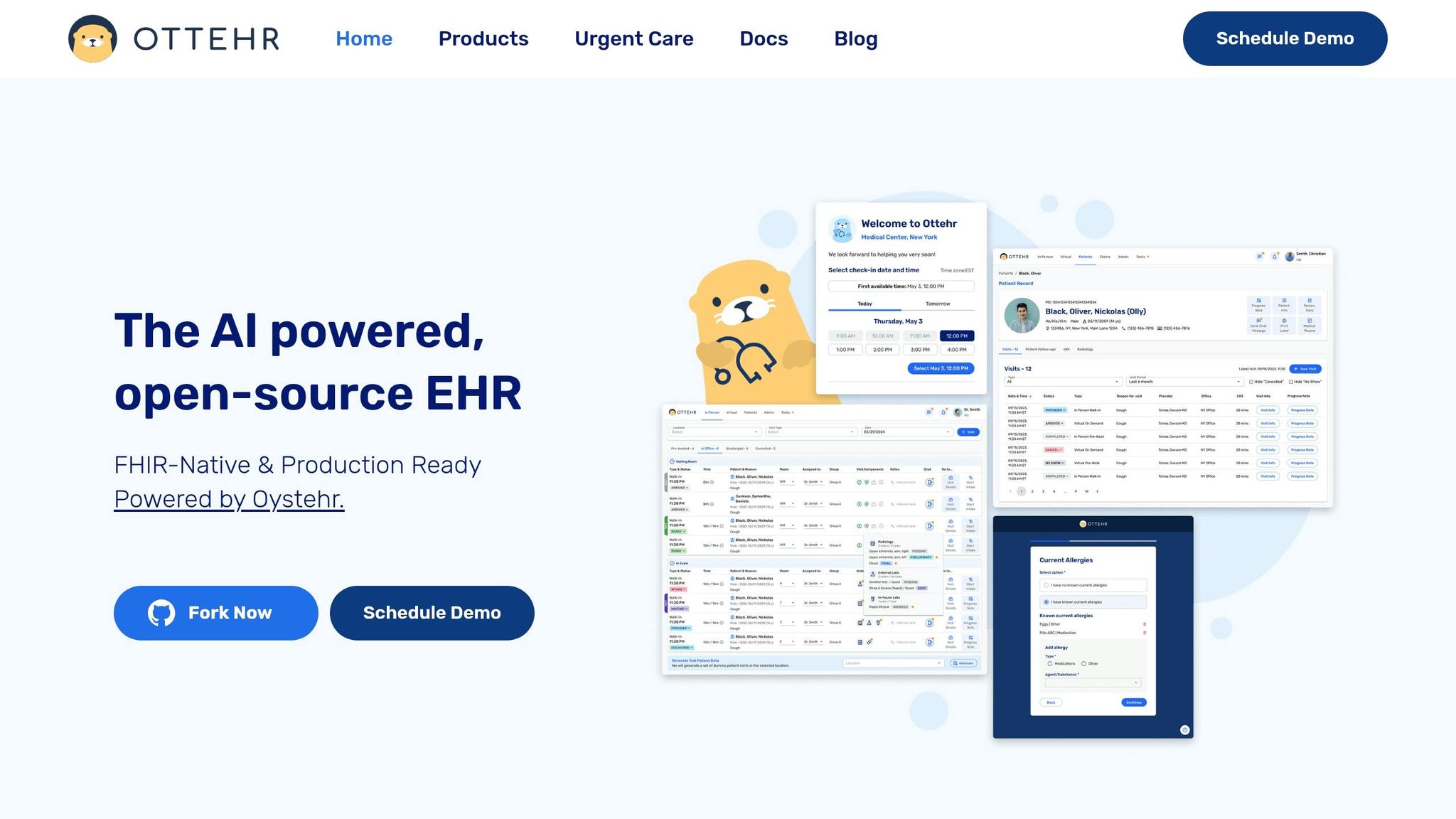
Ottehr's Revenue Cycle Management (RCM) solution is designed to fit seamlessly into your existing workflows. It works with your current systems, and every deployment includes allocated hours for customization. This means you can tailor the platform to align with your payer contracts, billing rules, and operational needs.
To get started, schedule a consultation with Ottehr's engineers. During this session, you'll discuss your clinical requirements and identify any challenges you're facing. Afterward, you'll complete an evaluation survey, which will generate a personalized action plan for your practice. Unlike rigid systems, Ottehr's FHIR-native, open-source architecture allows you to modify the code to meet your exact needs. This flexibility ensures your RCM workflow is fully optimized before diving into the implementation process.
The implementation itself focuses on three key areas: front-end accuracy, clinical documentation, and back-end automation. For instance, during patient registration, the system activates real-time insurance validation to spot coverage issues before treatment begins - addressing what experts call the top cause of billing exceptions. On the clinical side, the AI-powered scribe and coding assistant ensure encounter documentation is ready for claims submission. On the back end, the rules engine, charge master, and denial management system are configured to automate claim scrubbing and minimize manual follow-ups.
Pricing for Ottehr RCM starts at $599 per provider per month, covering claims submission, billing, and receivables management. There's also a Clinical tier at $349 per provider per month, which includes AI coding assistance and transaction-based payment processing at 2.9% + $0.30 per transaction. A free AI tier is available for testing core features. Below are the steps to implement Ottehr with minimal disruption.
Thanks to its headless service architecture, Ottehr allows you to roll out features gradually. Start with front-end validation to reduce registration errors, then add the AI coding assistant to improve documentation. Once your team is comfortable, activate the complete claims submission and denial management workflow for a smoother process.
Urgent care centers face increasing revenue cycle challenges that outdated manual billing systems can no longer handle. High patient volumes, combined with the complexities of insurance verification, coding, and claim submission, create inefficiencies that are costly. For example, 15% of claims are initially denied, with each denial rework costing an average of $118. In 2022 alone, U.S. hospitals and health systems spent a staggering $19.7 billion trying to overturn denials, highlighting the financial strain of reactive billing practices.
These challenges highlight the need for smarter, AI-powered solutions. Tools like real-time insurance verification catch coverage issues upfront, preventing eligibility-related denials before they occur. AI coding assistants help ensure clinical documentation is accurate, while automated claim scrubbing increases clean claim rates to an impressive 98.4%. Together, these technologies reduce denials and free up staff to focus on improving patient care instead of chasing claim rejections.
Ottehr’s integrated platform offers a comprehensive solution, combining front-end precision, accurate clinical documentation, and back-end automation into a unified workflow. Its FHIR-native architecture adapts to payer-specific contracts and billing rules, while the AI scribe and coding assistant ensure proper documentation from the start. With 63% of providers reporting shortages in revenue cycle management (RCM) staff, automation is no longer optional - it’s a necessity for maintaining financial health without overburdening teams. Leveraging these advanced tools can help urgent care centers achieve financial stability and dedicate more time to what matters most: patient care.
Urgent care facilities need to keep a close eye on a few critical daily KPIs to manage their revenue cycle effectively. These include:
By regularly tracking these metrics, facilities can spot potential problems early and maintain their financial stability.
To ensure patient balances are estimated and collected upfront, urgent care providers should prioritize early verification and effective communication. This process starts with real-time insurance eligibility checks during walk-in registration to confirm coverage and gather precise patient details. Clearly explaining financial responsibilities right from the beginning encourages payments before or at the time of service. This approach not only minimizes billing delays but also helps maintain a steady cash flow.
The fastest way to reduce recurring claim denials is to focus on accurate patient registration. This includes verifying insurance eligibility in real time and ensuring all patient details are documented correctly. On top of that, leveraging automation and staying compliant throughout the revenue cycle can help cut down on errors and boost claim acceptance rates.

Tell us what you need and we'll get back to you soon.