
Small documentation misses in urgent care quietly erase 1–5% of revenue—real-time AI charge capture stops the leakage.
I see the main point like this: small charting and billing misses turn into lost money, denied claims, and extra staff work. In urgent care, that adds up fast. The article shows that providers can lose 1% to 5% of net patient revenue from services that were done but never billed, while denied claims and rework push billing costs even higher.
Here’s the short version:
What I take from this is simple: manual coding often fails at the encounter level, while AI-driven charge review helps stop revenue loss before it turns into cleanup work, A/R delays, or write-offs.
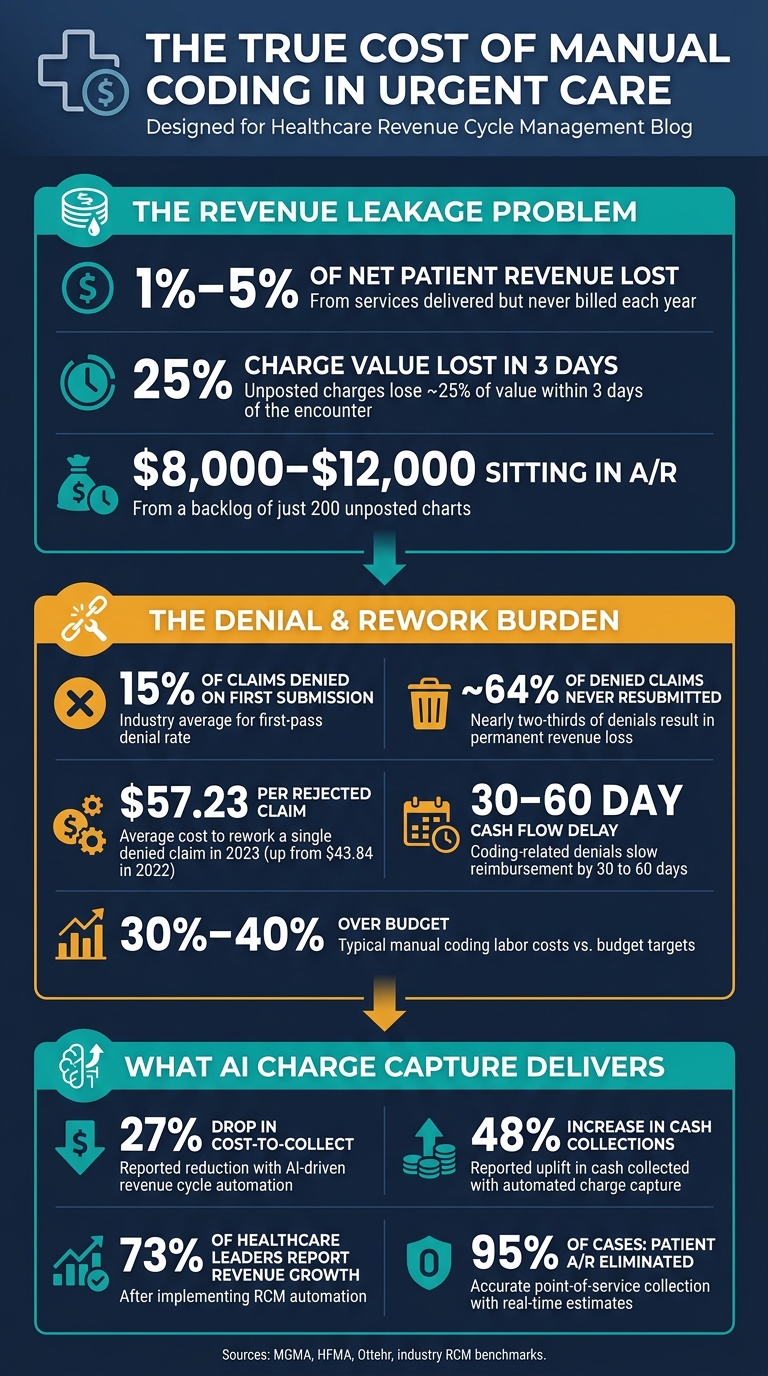
The True Cost of Manual Coding in Urgent Care: Key Stats at a Glance
Manual coding doesn't just create a few billing hiccups. It hits revenue from three angles: lost charges, denials, and rework.
Here's the hard part: healthcare organizations lose between 1% and 5% of net patient revenue each year from services that were delivered and documented but never billed.
Then there's labor. Manual coding costs often land 30% to 40% above budget once you factor in hiring, training, and oversight. And when claims get denied, the price keeps climbing. In 2023, the average cost to fight a single rejected claim was $57.23, up from $43.84 the year before.
In urgent care, small charting gaps can snowball fast. A missing modifier, incomplete procedure detail, or a missing procedure-to-diagnosis link can push a claim into downgrade or denial.
About 15% of claims are denied on first submission, and nearly two-thirds of those never get sent back in. At that point, the revenue isn't delayed. It's gone.
Once a claim is denied, staff have to stop what they're doing and clean it up. They pull the chart, ask the provider for more detail, fix the claim, and resubmit it. That adds days to accounts receivable and drags billing staff away from cleaner work. Manual triaging can add about 3 minutes per interaction. Three minutes may not sound like much, but across a busy urgent care center, it adds up fast.
Most urgent care losses are small enough to slip by in the moment. That's what makes them so expensive.
A provider may perform a laceration repair, but the note doesn't clearly state the wound length, anatomical location, or level of complexity needed to support the right CPT code. Or an injection or other add-on service gets done during the visit, but never makes it onto a billable line item before checkout.
Undercoding E/M levels is another common problem. When the note doesn't support the full complexity of the visit, the claim often gets billed at a lower level than it should. A thin or incomplete Medical Decision Making (MDM) section is a common reason. The care may have happened. The chart just doesn't back it up.
As Daniel Abrams explained:
"If the tests, procedures and other note details suggest that the provider has under coded the E&M level, the AI will mention this, and provide suggested documentation to include in the MDM to ensure a clean claim at the higher E&M rate." - Daniel Abrams, Ottehr
Timing matters too. Unposted charges can lose about 25% of their value if they aren't entered within three days of the encounter. In urgent care, that clock starts ticking right away. If charge capture doesn't happen before the visit wraps up, leakage can begin before the claim is even submitted.
Revenue leakage almost never comes from one big mistake. It usually shows up in small misses across the workflow - from intake and charting to charge posting and claim submission. Every handoff is one more spot where a charge can slip through the cracks. Later, those small misses turn into denials, delays, and write-offs tied to manual coding.
In urgent care, the most common problem areas are CPT-to-ICD-10 links, modifiers, add-on services, and E/M leveling.
| Leakage Source | Workflow Impact | Financial Impact |
|---|---|---|
| Missed CPT-ICD-10 Links | Claims are flagged for edits or denied on first-pass review. | Delayed cash flow and increased rework per claim |
| Missing Modifiers (26/TC) | Claims are submitted without the professional vs. technical component. | 30–60 day reimbursement delays |
| Missed Add-on Services | Procedures or tests performed are not carried from the note to the claim. | Direct revenue loss; invisible leakage until an audit occurs |
| Under-coded E&M Levels | Clinical complexity in the note is not reflected in the claim. | Lower reimbursement rates; recoverable revenue left on the table |
| Claim Rework | Repeated touches per claim; billing staff spend time on follow-up. | Higher cost-to-collect and extended accounts receivable cycles |
Most leakage starts before a claim is even sent. Manual entry leans on memory and extra clicks, which is where CPT codes, modifiers, and add-on services often get missed. That may sound minor, but it adds up fast.
Once the encounter closes, fixing a missed charge means reopening the chart later and doing cleanup work after the fact. In a busy urgent care setting, that step can easily get pushed aside or missed altogether.
When a claim goes out with errors, the problem doesn't end with the denial. It grows. Billing staff have to pull the chart, find the issue, correct it, and send the claim back out. Every one of those steps takes time, and every extra touch adds cost.
A backlog of just 200 unposted charts can leave $8,000 to $12,000 sitting in accounts receivable. Coding-related denials often slow cash flow by 30 to 60 days. That means more follow-up, more delay, and more strain on the billing team.
These are the kinds of gaps AI-driven charge capture can catch before the claim leaves the EHR.
Manual coding often leaks revenue for a simple reason: teams find errors too late. AI-driven charge capture helps catch missing services, modifiers, and documentation gaps before the chart closes. That includes missed procedure-to-diagnosis links and add-on services that can slip through during a busy day. The issue usually isn't effort. It's workflow.
Instead of asking a provider to remember every billable service at the end of a packed shift, AI reviews the clinical progress note in real time and suggests CPT and ICD-10 codes based on what's documented in the note.
This matters a lot for E/M leveling. AI can draft the Medical Decision Making (MDM) statement needed to support a higher-complexity visit and point out gaps before final sign-off, not later during billing review. Providers can click those suggestions right into the note without leaving the chart. That cuts friction and helps teams capture the right code on the first pass.
When a billable procedure appears in the documentation, the matching CPT code can be suggested automatically, which lowers the chance of a missed charge. EHR workflows can also require key procedure fields, so providers can't finalize the chart until the documentation is complete. Pair that with automated claim validation, which flags missing modifiers and other documentation issues before submission, and teams can fix errors before they turn into denials.
Those front-end checks reduce denials and cut rework later on.
When front-end checks happen inside the EHR, the money impact shows up fast. AI-driven charge capture can cut cost-to-collect, increase cash collections, and reduce denials by catching billable services before claims leave the EHR. In plain English: it helps teams catch the charges manual workflows often miss, like procedure-to-diagnosis links, add-on services, and documentation gaps. That’s why the payoff shows up in two places at once: fewer denials and faster cash flow.
Cost-to-collect can drop by as much as 27%, and cash collections can increase by up to 48%. Real-time patient responsibility estimates also move collections to the point of service.
"In 95% of cases, this can eliminate patient AR. The entire patient responsibility can be accurately collected at time of service." - Daniel Abrams, Ottehr
On top of that, 73% of healthcare leaders reported revenue growth after putting RCM automation in place. The main drivers are pretty straightforward: fewer missed charges, fewer denials, and less rework.
The payoff from AI charge capture depends on how closely it fits into the EHR workflow. If the tool sits outside the EHR, staff usually end up doing extra work instead of less.
Here’s what to focus on:
Potentially more than many centers realize.
About 15% of medical claims are denied on the first pass. And 50%–65% of those denials never get sent back in, which means that money is often lost for good. On top of that, undercoding, missed procedure or radiology charges, and weak documentation can chip away at revenue even more.
The dollars pile up fast. Each denial costs an average of $118 in rework labor. At the same time, stronger coding and better documentation can add $10–$15 per visit while also improving clean claim rates.
In urgent care, the pace is relentless. Patients keep coming, charts stack up, and small documentation gaps can turn into lost revenue.
One of the biggest trouble spots is radiology orders. They’re often missed in the charting process. On top of that, providers may fall back on lower-level E/M codes, which can leave 15% to 30% of revenue per visit on the table.
A few other problems show up all the time:
Adding AI charge capture to your EHR is usually manageable and often takes 4 to 12 weeks.
The timeline often comes down to one thing: whether your EHR supports standard interoperability formats like FHIR or X12 837. If it does, setup tends to move along with less friction.
Implementation usually includes a few core tasks:
One more tip: train staff in your live environment, not a demo system. That gives people practice in the place where they’ll do the work every day, which can make adoption smoother.

Tell us what you need and we'll get back to you soon.