
Front-desk insurance errors, coding and documentation gaps, denials, and slow payment posting are the main causes of urgent-care revenue loss.
Most urgent care billing problems start before the claim is sent. A bad insurance entry, the wrong code, an unsigned chart, a duplicate resubmission, or slow payment posting can all delay cash and add extra work.
Here’s the short version: if you want fewer billing issues, I’d focus on five areas first:
The cost of getting this wrong adds up fast. The source article notes that RCM automation cut cost-to-collect by 27%, and 73% of healthcare leaders said revenue grew after adoption. That tells me one thing: small billing mistakes are expensive, and better process checks can lower rework.
If I had to sum up the article in one line, it would be this: clean data in, clean claims out. Most billing trouble in urgent care follows the same path from front desk to coding to denials to posting.
| Problem area | Common issue | What helps |
|---|---|---|
| Check-in | Wrong payer, inactive coverage, bad member ID | Real-time eligibility checks |
| Coding | Wrong E/M level, missing modifier, code mismatch | Pre-bill edits and direct code pull from chart |
| Documentation | Open charts, unsigned notes, missing procedure details | Required sign-off before claim release |
| Denials | Repeat filing errors, duplicate resubmits | Claim status checks and denial tracking |
| Payment posting | Manual backlog, unmatched ERAs | Exception queues and posting audits |
So if you’re seeing more denials, slower payments, or staff spending too much time fixing old claims, these are the first places I’d check.
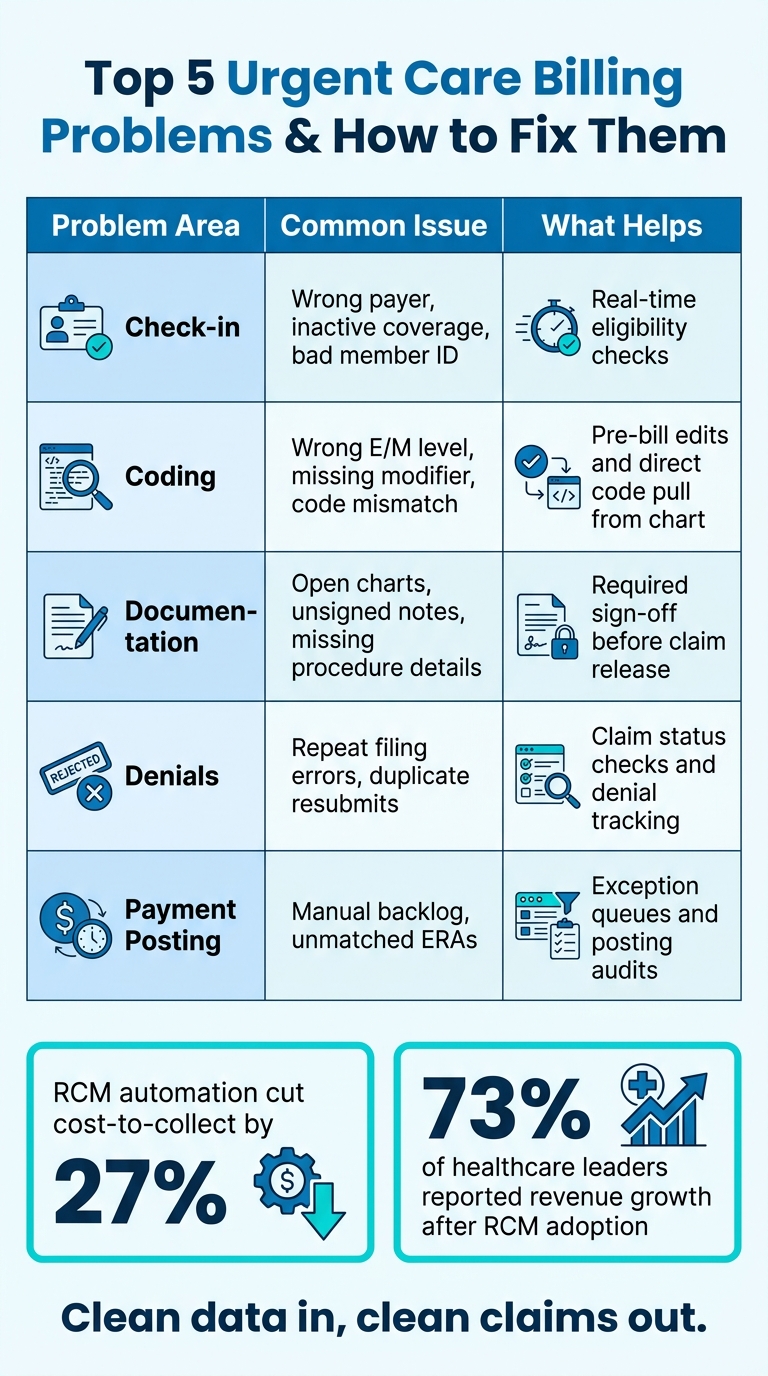
Top 5 Urgent Care Billing Problems & How to Fix Them
A lot of claim problems begin at the front desk. If the wrong payer is entered, the member ID is off by one digit, or coverage has gone inactive, that mistake can turn into a denial before the visit even gets moving.
COB matters here too, especially when a patient has more than one plan. If the primary and secondary plans are entered in the wrong order, the bill can land on the patient instead.
The most common registration errors look minor on the surface, but they can cost a lot. A transposed member ID, a subscriber name that doesn’t match the payer file, or insurance details that are no longer current can all derail a claim. Sometimes patients show up with old coverage information, and that sends the claim down the wrong path from the start.
Automated eligibility checks verify coverage before the visit and reduce denials. The actions that matter most are pretty simple:
On-screen prompts also help staff catch missing or incorrect subscriber details during a high-volume check-in.
Clean eligibility data gives coding and claim submission a cleaner starting point.
Once eligibility is confirmed, the next billing risk is coding the visit the right way. In urgent care, things can go off track fast. Visits move quickly, documentation may be thin, and coders still need to assign the right E/M level, modifiers, and any supply or injection codes based on what happened in the encounter.
Visits with injections or supplies need HCPCS and NDC codes captured during the clinical encounter and passed over correctly to the billing claim. If that handoff slips, the claim can go out with missing details or codes that don’t match.
Another common problem is choosing the wrong E/M level. Modifier mistakes show up a lot too, especially when the modifier doesn’t match the service or the payer’s rule. That mix leads to denials, back-and-forth work, and time lost fixing claims that should have gone out clean the first time.
The answer isn’t piling on more manual review. It’s using automated edits before the claim leaves the system.
Automated edits can catch:
When the billing workflow pulls codes straight from the encounter into the claim, there’s less room for manual entry mistakes. Automation can also flag code-to-documentation mismatches before submission, which helps stop claim edits before the rework starts.
Even when the codes look right, the claim can still fail if the chart doesn’t support them.
Even a clean claim can still fail if the chart doesn’t support the service. That’s the part many teams feel in day-to-day work: when documentation is thin, coding slows down, billing stalls, and payment gets pushed further out.
Missing procedure notes, unsigned encounters, and open charts can all lead to rejection, downcoding, or audit denial.
Unsigned encounters and incomplete chart sign-off are a major headache because billing often can’t move forward until the provider finishes the record. If the chart is still open when the claim goes out, staff usually have to pause it or come back and fix it later. Either way, cash flow takes a hit.
Most denials come from filing mistakes or policy limits that automated checks can catch much earlier. Some happen for a simpler reason: a claim gets resubmitted before anyone checks its status. That can create a duplicate charge, which may lead to payer audits or recoupments.
Automated denial management can spot patterns in denied claims so billing teams can fix root causes instead of reworking each denial one by one.
The three most common errors in this category, and how to stop them:
Once denials and duplicate charges are under control, the next bottleneck is payment posting.
Even after a claim gets paid, cash may not hit the books right away. Approval isn't the finish line. Payment posting and reconciliation can still slow down cash.
The most common cause is manual posting backlogs. When staff post payments by hand from EOBs, or when ERAs don't line up with claims, the queue can pile up fast. And if the practice doesn't have a set reconciliation process, unmatched items tend to sit there, open and unresolved, which drags out reimbursement.
Unclear remits create another problem: balances stay in accounts receivable longer than they should. The answer isn't more cleanup after the fact. It's a tighter posting workflow from the start.
Urgent care teams need a steady routine for posting and reconciliation if they want cash to keep moving. A simple exception queue for unmatched ERAs helps staff flag problem items before they disappear into a general inbox. RCM analytics can show exactly where payments stall during posting, and regular posting audits help catch unapplied cash and mismatched payments before they pile up.
Repeat billing errors usually come from inconsistent workflows. The fix is pretty simple: standardize each step, catch exceptions early, and stop claims from moving forward when key data is missing.
Start at the front desk. Verify coverage in real time at check-in before the visit moves forward.
Then tighten up the handoff to billing. Validate codes and modifiers before every submission, and map internal codes to payer codes before the claim goes out. It sounds basic, but this is where a lot of repeat mistakes begin.
Another smart control: block claim release until the note is complete and signed. If documentation is still unfinished, the claim shouldn't leave the queue. That one rule can prevent a lot of rework later.
Once claims are clean at submission, the next job is stopping denials from boomeranging back into the system. Review denial trends on a set schedule so recurring issues can be fixed at the workflow level, not patched one by one after the fact.
It also helps to audit payment posting on a regular basis. That makes it easier to spot delays and unmatched items before they pile up.
Ottehr supports these controls with AI charting, AI coding assistance, configurable workflows, claims submission, denial management, and RCM reporting. That makes billing problems easier to catch before they turn into avoidable delays.
Start by setting a performance baseline with key metrics like denial rates, first-pass clean claim rates, and days in accounts receivable.
Review these numbers daily. Then dig into denial reasons such as eligibility errors, coding mistakes, or incomplete documentation. That gives you a clear view of which providers or codes are driving the most rejections, so you can fix repeat bottlenecks before they hit revenue.
The biggest cash flow problems usually come from insurance verification errors, coding and documentation issues, and claim denials. Something as simple as incorrect patient details or expired coverage can trigger an immediate rejection.
Coding mistakes, including modifier misuse and missing medical necessity support, drive 35% of denials. And here's where the problem gets expensive: 60% of denied claims are never resubmitted. That means errors that look small on the front end can turn into permanent lost revenue. Missing copays and deductibles at the time of service also adds to bad debt.
Urgent care claims should be held for manual review when automated systems flag them as high-risk. That extra check can help stop avoidable rejections before they happen, which saves time and cuts down on costly rework.
Claims should also be held if they have:

Tell us what you need and we'll get back to you soon.