
Seven urgent care EHR essentials: AI scribes, OCR scanning, e-prescribing, kiosks, templates, coding, and real-time labs.
Urgent care centers need fast, efficient tools to manage high patient volumes and unpredictable workflows. A modern EHR designed for urgent care can improve efficiency, reduce errors, and enhance patient experiences. Here's what to look for:
Key takeaway: The right EHR system eliminates inefficiencies, reduces staff workload, and ensures patients get timely, high-quality care. If your current system feels outdated or slows you down, it may be time to upgrade.
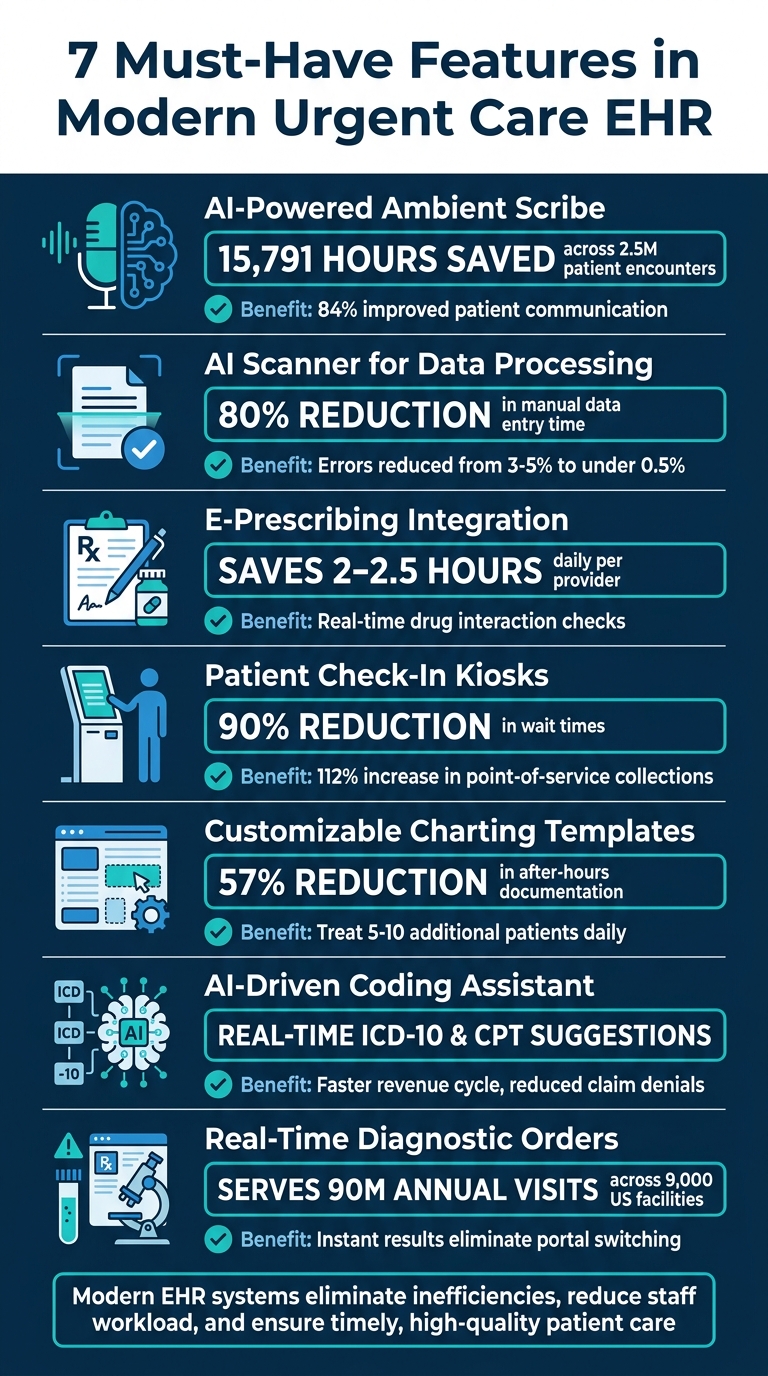
7 Must-Have Features in Modern Urgent Care EHR Systems
AI-powered ambient scribes have become a game-changer for urgent care EHR systems, improving both operational efficiency and the quality of patient care.
These advanced tools work by listening in on conversations between clinicians and patients, automatically generating clinical documentation. This allows providers to concentrate entirely on their patients while the AI handles the paperwork.
For instance, between October 2023 and December 2024, The Permanente Medical Group (TPMG) deployed ambient AI scribes for 7,260 physicians. Across 2,576,627 patient encounters, this saved an incredible 15,791 hours of documentation time. To put that into perspective, that’s the equivalent of 1,794 eight-hour workdays. High-frequency users saw even greater benefits, saving 2.5 times more time per note compared to those who used the technology less often.
But the benefits don’t stop at efficiency; these tools also help improve the quality of patient interactions.
Ambient scribes do more than just save time - they remove the distraction of screens, allowing providers to maintain eye contact and engage more meaningfully with patients. In one large-scale rollout, nearly half (47%) of patients noticed their doctor spent less time looking at the computer, and 39% felt their doctor spent more time speaking directly to them.
This technology also plays a role in reducing physician burnout. Among those using AI scribes, 84% said it positively impacted patient communication, and 82% reported greater job satisfaction.
Additionally, platforms like Ottehr’s AI-native system, which has been used in over 1,000,000 urgent care visits, take things a step further by suggesting accurate ICD-10 and CPT codes based on the conversation. This ensures billing precision while allowing providers to stay focused on delivering care.
AI scanners simplify the handling of documents like insurance cards, referrals, and IDs. By using OCR (Optical Character Recognition) technology, they take over much of the manual data entry that traditionally bogged down front-desk operations and led to frequent errors.
In April 2026, Syntora shared impressive results from implementing a custom AI workflow automation system at a 30-employee urgent care center. By leveraging the Claude API for document understanding, the system parsed insurance cards and referrals while seamlessly connecting to existing EMRs and insurance portals. This setup cut manual data entry time by 80% and was rolled out in just 4–6 weeks.
"AI reduces administrative burden for urgent care by automatically parsing insurance cards and referrals, cutting data entry time by over 80%." – Parker Gawne, Founder at Syntora
The benefits don't stop there. These scanners also reduced data entry errors from 3–5% to under 0.5% and trimmed referral processing times from 5–7 minutes to less than 60 seconds. Such advancements make integrating AI scanners into daily workflows a game-changer for urgent care operations.
AI scanners excel at transforming unstructured data from various sources into a structured format that integrates directly with EMRs. This is particularly useful for Workers' Comp and Occupational Medicine cases, where capturing detailed data quickly is essential. Additionally, these tools work seamlessly with systems like Epic, Cerner, or Experity, using FHIR or HL7 feeds to enable real-time data synchronization.
Beyond streamlining workflows, AI scanners play a role in improving patient care. By ensuring accurate documentation and minimizing billing errors - up to a 70% reduction compared to manual methods - these tools help avoid treatment delays. Complete and accurate records support better long-term patient outcomes, while automated systems save urgent care facilities over 10 staff hours each week by handling routine tasks like lab result notifications and data processing.
E-prescribing integration simplifies the process of managing medications by allowing prescriptions to be sent digitally. This eliminates the need for manual tasks like paperwork, phone calls, and faxing, making the process faster and more efficient.
Today's e-prescribing systems consolidate all medication data into a single view while offering mobile-friendly features. This means clinicians can prescribe medications right at the bedside, perform automated history checks, and search pharmacies with ease. These tools collectively save healthcare providers between 2 to 2.5 hours daily. Systems with EPCS (Electronic Prescribing for Controlled Substances) certification are especially valuable, as they allow for the digital management of all prescriptions, including those for controlled substances.
This time-saving functionality not only improves workflow but also creates opportunities to focus more on patient care.
E-prescribing systems improve safety by running real-time automated checks for potential drug–drug and drug–allergy interactions. This significantly reduces the chance of medication errors, cutting out the need for manual verifications.
"Streamlines the prescribing process and enhances patient safety by reducing medication errors, preventing adverse drug interactions, and ensuring prescriptions are filled accurately and quickly." – Oystehr
Modern e-prescribing tools are built to integrate smoothly with existing healthcare systems. Using HL7 standard language and FHIR-compliant APIs, these systems ensure medication data flows effortlessly across hospitals, labs, and pharmacies. This level of interoperability is especially critical in urgent care settings, where patients may arrive with prescriptions from multiple providers. EHRs connected to major networks like Surescripts provide broad pharmacy access and enable accurate retrieval of medication histories.
Patient check-in kiosks bring self-service registration to the forefront, simplifying front-office tasks. Patients can directly input their demographic details, scan insurance cards and IDs, sign consent forms electronically, and even make co-payments. By allowing direct data entry, these kiosks reduce transcription errors and free up front-desk staff to handle more complex responsibilities, such as insurance verification or assisting patients. This self-service model not only improves accuracy but also boosts operational efficiency.
The efficiency benefits of kiosks are hard to overlook. They handle high patient intake volumes while automating much of the data entry process. For example, kiosks can reduce registration workload by up to 87% and cut patient wait times by an impressive 90%. When patients enter their information directly, the system immediately notifies clinical staff that the patient is ready, removing the need for manual communication between the front desk and care providers.
"I intake around 70 patients a day. With this EMR system, my job has become a breeze. It's straightforward and intuitive, allowing me to efficiently gather patient information, collect payments and schedule patients." – Intake Specialist, UrgentIQ
Another key feature is the ability to perform real-time insurance eligibility checks during check-in. This ensures coverage is active before the patient is seen, minimizing billing errors. Practices using kiosks report an average 112% increase in point-of-service collections. For urgent care centers managing large numbers of walk-in patients, this capability is essential to maintaining steady cash flow and reducing claim rejections.
Integrated kiosks enhance efficiency further by ensuring that patient-entered data flows directly into existing systems. These kiosks sync with EHR and Practice Management platforms, eliminating the need for manual data re-entry. Equipped with industrial-grade scanners, they capture clearer images of IDs and insurance cards compared to tablet-based solutions. By adhering to HL7 or FHIR standards, kiosks maintain data accuracy across the care continuum - from check-in to billing. Additionally, integration with queue management displays provides real-time updates on wait times and patient positions, reducing anxiety and discouraging walk-outs during busy periods.
"With the kiosks, patients can more accurately provide their information, and we can move our staffing resources to more valuable areas, like verification, which helps us get paid faster and save time." – Jeremy Gibbs, Director of Finance, Pulmonary Associates
Customizable charting templates are a game-changer for urgent care facilities, working hand-in-hand with AI technologies and streamlined data handling to make workflows faster and more efficient.
Urgent care thrives on speed and precision, with patients often expecting to be seen and treated within 15 to 30 minutes. Generic templates can slow things down with unnecessary clicks and windows that disrupt this fast-paced environment. Customizable templates, however, are designed specifically for common urgent care scenarios - like respiratory infections, minor injuries, sprains, and lacerations. These templates guide providers step-by-step through documentation while allowing real-time updates, which keeps things moving smoothly. Some EHR systems even offer libraries with over 1,300 pre-made templates, which can be tailored to fit your specialty and workflow. This flexibility ensures the software adapts to your practice, not the other way around.
Saving time means seeing more patients. AI-powered documentation tools can free up 2–2.5 hours per day for clinicians, enabling them to treat 5 to 10 additional patients daily. The adoption of AI in tasks like charting and visit notes has grown significantly, with 66% of physicians using it in 2026, compared to just 38% two years earlier. These smart templates can create real-time drafts during patient consultations, automatically organizing key details into sections like History of Present Illness (HPI) and Assessment and Plan (A/P).
Beyond documentation, these templates also enhance billing accuracy. They can suggest Evaluation and Management (E/M) codes based on the provider's notes, reducing the risk of audits and ensuring claims are accurate. This level of precision not only supports quicker treatments but also boosts patient throughput. Additionally, smarter workflows have been shown to cut after-hours documentation by 57%, giving clinicians more time for themselves while maintaining high-quality, compliant records.
Customizable templates don’t just improve efficiency - they also integrate seamlessly with other systems. Using HL7 or FHIR standards, these templates ensure smooth data exchange with labs, radiology centers, and pharmacies, eliminating the need for manual data entry. For practices with multiple locations, standardized templates help maintain consistency across sites, simplifying data sharing and ensuring compliance with regulations. When choosing an EHR system, look for one that lets you tweak forms, screens, and patient messaging flows to suit your unique operational needs.
"The thing I really liked was how much input we had from the team at Heidi. The way it fit into our business was a game-changer." – Shanan Nelson, Director and Senior Physiotherapist, SANA Physiotherapy
In the fast-paced world of urgent care, AI-driven coding assistants are proving to be a game-changer. They simplify billing workflows while ensuring accuracy, even under the pressure of high patient volumes.
AI coding assistants are designed to provide precise, specialty-specific guidance during clinical encounters. This helps clinicians accurately capture charges on the spot. With tools like smart diagnosis search and automated charge capture, providers can quickly identify the correct ICD-10 and CPT codes during patient visits. This is particularly useful in urgent care settings where quick turnaround and high patient traffic demand real-time billing solutions.
AI-powered claim scrubbers take efficiency to the next level by validating billing information before submission. This reduces errors that could lead to claim denials or resubmissions, speeding up the revenue cycle and ensuring faster reimbursements.
One internal biller at UrgentIQ shared their experience:
"Transitioning to this EMR system has revolutionized our billing process. It's efficient, and I can process claims and invoices with ease. The system's simplicity and automation has reduced the chances of errors, and it has had an impact on our revenue cycle."
A nurse practitioner at the same facility echoed this sentiment:
"Our team no longer has to spend hours clicking through complex interfaces, allowing us to devote more time to our patients."
By cutting down on the time spent navigating coding challenges, clinicians can dedicate more attention to their patients. Faster, more accurate documentation enhances the overall patient experience, while AI-powered chart reviews ensure compliance and completeness without requiring extra work after the visit. These improvements not only benefit patients but also create a more streamlined workflow for providers.
Modern AI coding assistants are designed with API-first and AI-native architectures, making it easier to integrate them with Practice Management systems and clearinghouses. This enables real-time charge capture and centralized accounts receivable management. When choosing an EHR system, it's important to select one that includes a coding assistant integrated into revenue cycle management tools. Additionally, FHIR-compliant systems ensure smooth data exchange across the care continuum, maintaining accuracy when collaborating with specialists and other healthcare providers.
After streamlining documentation and billing processes, integrating real-time diagnostic tools takes urgent care workflows to the next level.
Real-time diagnostic integration has reshaped how the 90 million annual visits across 9,000 U.S. urgent care facilities are managed. By allowing providers to order lab tests or imaging and view results directly within a patient’s chart, it eliminates the need to navigate multiple vendor portals.
Modern EHR systems seamlessly connect with national lab networks such as LabCorp, Quest, and Health Gorilla through FHIR-compliant APIs. Mobile features further enhance this integration, enabling providers to order tests and review results via tablets or smartphones. This functionality supports real-time, bedside discussions with patients as soon as the data is available.
Automation plays a big role here, with diagnostic results automatically transferred into the EHR, removing the need for manual data entry. This not only reduces the risk of human error but also saves staff time that would otherwise be consumed by paperwork and reconciling data.
"Automation is no longer simply an option in the revenue cycle - it is an imperative."
– Amy Raymond, Senior Vice President of Revenue Cycle Operations and Deployments, AKASA.
Instant access to diagnostic results supports faster diagnoses, enabling clinics to handle a higher patient volume. Middleware solutions further enhance this process by linking diagnostic devices directly to EHR systems, ensuring results are reported immediately. This speed in accessing diagnostic data directly impacts the quality and timeliness of patient care.
Building on earlier improvements, the ability to access diagnostic data instantly enables quicker diagnoses and treatment decisions - critical in urgent care’s fast-paced environment.
"It's not only safer for the patients; it makes the practice environment better for all three clinicians: physicians, pharmacists, and nurses."
– Linda Burnes Bolton, Chief Nursing Officer at Cedars-Sinai.
Automated tracking and notifications ensure critical results are flagged and reviewed promptly, helping avoid delays in follow-up care. This approach not only improves patient safety but also enhances overall care coordination.
Today's EHR systems need to keep up with the fast-paced, high-volume demands of urgent care. Tools like AI-powered ambient scribes and real-time diagnostic integration help cut down documentation time, streamline patient flow, improve clinical safety, and maintain financial stability. These advancements pave the way for a smoother and more effective urgent care experience.
If your current system feels outdated - requiring too many clicks, duplicate data entry, or lacking templates tailored to your specialty - it might be draining both your time and money. As Experity points out:
"An EMR that does not help you face current challenges, like accommodating higher visit volume, can cost clinics time, money, and frustration".
To stay competitive, it's crucial to assess your EHR system thoroughly.
Check for factors like documentation speed, HL7/FHIR-compliant data exchange, mobile-friendly features, and support for virtual waiting rooms, real-time insurance verification, and AI-driven coding. If creating clinical notes regularly takes more than a few minutes, it’s a sign your system isn’t pulling its weight.
A modern EHR can revolutionize both patient care and daily operations. With deployment possible in less than 24 hours, it can also enhance staff satisfaction by removing inefficient processes. In a tight job market, operational efficiency isn’t just a perk - it’s a necessity for attracting and keeping top talent.
If your urgent care EHR feels sluggish, it might be time to evaluate how it's affecting your workflow and patient care. Some red flags include longer check-in times, delays in accessing or updating patient records, and communication breakdowns during critical moments. Additionally, an EHR that doesn't support real-time data sharing, customizable templates, or integrated scheduling tools could be holding your practice back, making everyday operations more cumbersome than they should be.
Yes, AI tools like ambient scribing are built to meet HIPAA requirements. They incorporate strong security measures, including bank-level encryption, to safeguard patient data and ensure it remains protected.
When evaluating HL7/FHIR integration, it's important to ask vendors whether their system aligns with FHIR standards for real-time data exchange and interoperability. Check if their platform includes FHIR-compatible APIs, supports secure data sharing, and meets federal interoperability regulations. You should also ask about their experience with cloud-based workflows, the ability to provide real-time access to patient records, and how well their system integrates with existing EHRs, labs, and other healthcare platforms to enhance care coordination.

Tell us what you need and we'll get back to you soon.