
AI, predictive analytics, and real-time dashboards cut urgent care wait times, improve safety, and optimize staffing.
Long wait times and overwhelmed staff are common challenges in urgent care centers. Here's how AI and data tools are stepping in to address these issues:
AI is proving to be a game-changer for urgent care by reducing delays, improving patient outcomes, and easing staff workloads. The following sections dive into specific tools and strategies reshaping patient flow.
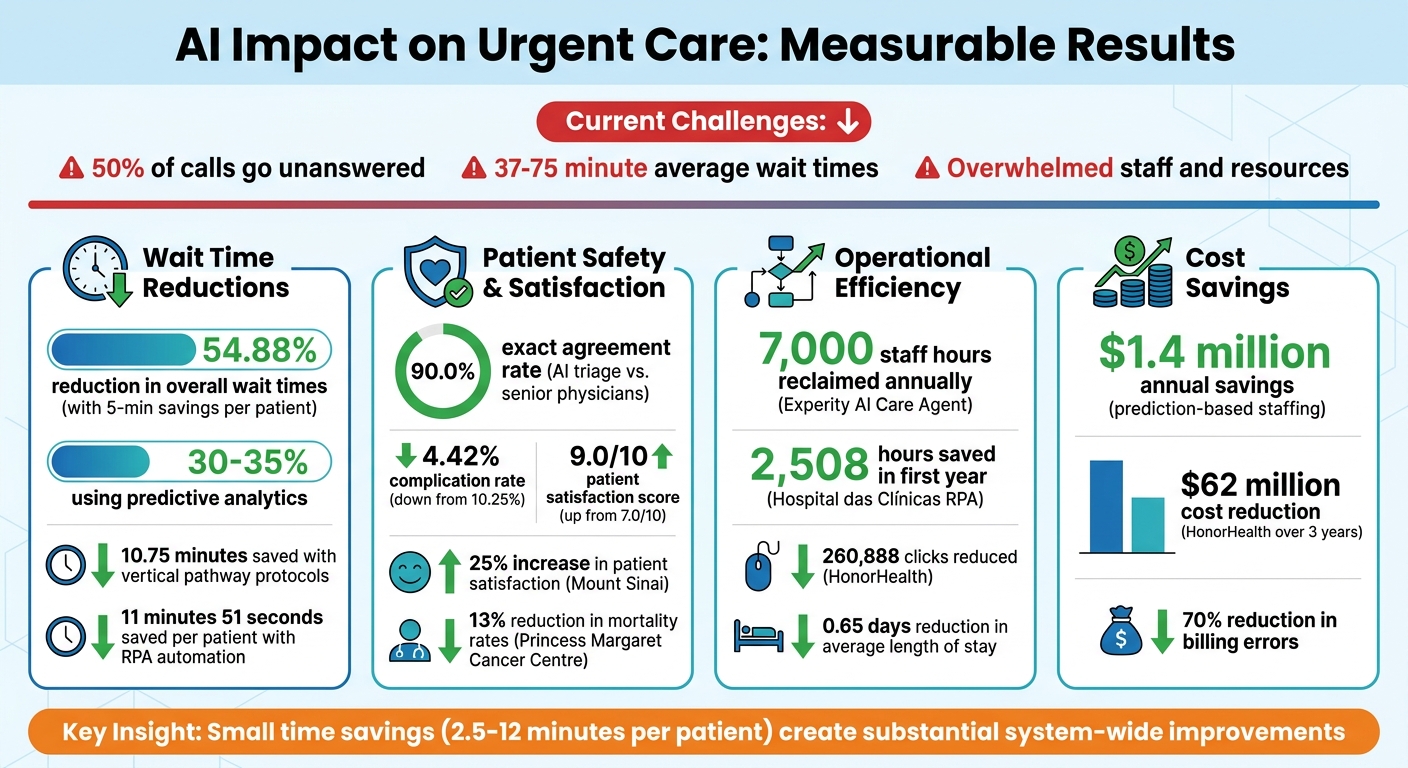
AI Impact on Urgent Care: Key Performance Metrics and Outcomes
AI-driven triage systems are transforming how patients are assessed and directed for care. By leveraging Large Language Models (LLMs) and Natural Language Processing (NLP), these systems analyze patient interactions and clinical data with a high degree of reliability, minimizing the variability of human judgment.
The impact of these systems is evident in real-world applications. For example, between June and December 2024, the Adult Emergency Department at Lille University Hospital in France tested the URGENTIAPARSE model. This hybrid system, which combines FlauBERT and XGBoost, was evaluated across 73,236 emergency visits. Researchers Edouard Lansiaux and Eric Wiel reported that the model achieved a 90.0% exact agreement rate with senior emergency physicians' assessments. Notably, it also reduced the risk of undertriage compared to standard nurse-led practices.
Another compelling example comes from a 2026 study comparing an AI-supported triage system (Infermedica) with the Manchester Triage System. Among 18,000 adult patients, the AI-supported group saw complication rates drop to 4.42% from 10.25%, a significant improvement. Beyond safety, patient satisfaction scores rose from 7.0 to 9.0 on a 10-point scale, and in-facility mortality rates declined, with an odds ratio of 0.39.
"AI systems in emergency medicine can process diverse data, operate continuously, and provide consistent and transparent decisions." - JMIR Medical Informatics
The consistency and reliability of these AI systems pave the way for even more advanced tools, such as predictive algorithms, to manage patient flow effectively.
Building on the stable outcomes of AI triage systems, predictive algorithms take patient flow management to the next level. By analyzing patterns in patient data, these algorithms enhance resource allocation and streamline care pathways, delivering measurable efficiency gains.
A notable example comes from a 13-week trial that concluded in June 2025. Researchers, including Soroush Saghafian, developed a non-linear machine learning model trained on 49,350 patient encounters. The system identified patients suitable for "vertical processing", where care is provided in a chair rather than a bed. This approach focused on specific patient groups, such as ESI 4 and 5 patients, along with ESI 3 patients presenting with skin, urinary, or eye complaints. The results were impressive: the average length of stay was reduced by 10.75 minutes, all while maintaining safety metrics like 72-hour revisit rates.
These examples highlight how AI-powered tools, from triage systems to predictive algorithms, are reshaping emergency care by improving efficiency, safety, and patient satisfaction.
Real-time dashboards give urgent care facilities a clear picture of patient flow by tracking metrics like patient census, arrival rates, and wait times at every stage - from registration to discharge. This continuous monitoring helps identify bottlenecks as they form, allowing staff to address issues before they escalate into major delays.
Between May and September 2022, a large adult emergency department with 90,000 annual visits tested a prediction-based staffing framework using Google Apps Script. The result? An estimated annual savings of $1.4 million, all while keeping patient throughput steady.
"The prediction-driven staffing framework, by analytically optimizing resource allocation, achieved a more adept balance between staffing costs and service quality." - npj Health Systems
The data also highlights how sensitive patient flow is to staffing levels. For every nurse hour below recommended levels, patient wait times increase by an average of 2 minutes. If understaffing exceeds 20% of the suggested levels, delays can grow by an additional 2.3 minutes.
With these real-time insights, urgent care facilities can make dynamic adjustments that improve patient flow and reduce delays.
Taking the information from live dashboards a step further, dynamic resource reallocation allows urgent care centers to adjust staffing and resources in real time. This approach uses a two-stage prediction model: a "base" stage for scheduling weeks in advance and a "surge" stage that refines staffing requirements based on real-time data, such as current patient census and weather forecasts, within 24 hours of a shift.
In August 2025, Experity launched its AI Care Agent across several urgent care clinics. By February 2026, this tool had supported over 650,000 patients by automating routine tasks such as follow-ups and lab result updates. Led by Ian Lyman and Jonathan Moss, the initiative reclaimed 7,000 staff hours and reduced waiting room stress by offering automated, real-time status updates via SMS and web chat.
"Staff is doing the work that improves experience and throughput rather than repeating administrative tasks." - Jonathan Moss, Executive Vice President, Experity
These AI-powered automation tools not only streamline resource allocation but also free up clinical staff to focus on patient care, ensuring operational efficiency without sacrificing service quality.
Care pathway optimization takes patient management in urgent care to the next level by refining treatment strategies and improving patient flow. Building on dynamic resource allocation and AI-predictive routing, this approach tailors the care process to individual needs.
Vertical pathway protocols use machine learning to analyze triage data and determine which patients can remain upright and mobile during care, rather than requiring a bed. This method relies on risk scores generated from a combination of symptoms, medical history, and vital signs to guide patient routing.
A 13-week trial conducted in mid-2025 tested a non-linear ML model on 49,350 patient encounters. The results? A 10.75-minute reduction in the average length of stay, all without increasing 72-hour revisit rates. The system's adaptive eligibility criteria dynamically adjusted patient routing based on real-time facility saturation levels.
"A personalized, data-driven VPP protocol, enabled by ML predictions, significantly improved the ED throughput while preserving care quality. Unlike standard fast-track systems, this approach adapts to ED saturation and patient acuity." - Nicole R. Hodgson, Soroush Saghafian, et al.
The standout feature here is adaptive eligibility. Unlike traditional systems with rigid rules, these protocols adjust in real time based on facility capacity. This flexibility helps avoid bottlenecks in waiting rooms during patient surges.
Vertical pathway protocols offer a personalized approach, but comparing them with fast-track models highlights additional opportunities for automation and scalability. Traditional fast-track systems use fixed criteria to identify low-acuity patients, while adaptive models take efficiency a step further by automating processes and removing unnecessary steps.
Adaptive systems shine in their ability to automate tasks. For instance, Robotic Process Automation can handle much of the registration process using modernized healthcare modules, and digital history-taking tools consistently save time compared to hiring extra staff. Unlike physical personnel, who may be underutilized during slower hours, digital tools provide consistent per-patient time savings .
"Small time savings in the history-taking process have potential to result in substantial reductions in total patient waiting time for triage nurses, with likely effects of reduced patient anxiety, staff anxiety, and improved patient care." - Maryam Montazeri, et al.
AI can bring operational improvements, but its success in urgent care depends on how well it’s customized, integrated into existing systems, and embraced by staff. Bridging the gap between AI's potential and actual results often boils down to these three factors.
AI tools aren’t one-size-fits-all. They need to be tailored to the specific needs of your facility. For example, algorithms must be retrained using datasets that reflect your patient population’s demographics and health trends. An AI model built for a large urban hospital might not perform well in a suburban urgent care center with a completely different patient mix.
Beyond accuracy, AI tools should simplify decision-making by offering clear, actionable insights. For instance, instead of overwhelming clinicians with raw data, they might suggest prioritizing certain discharges.
"The benefit isn't that AI makes the decision for clinicians, it's that it reduces the cognitive load of weighing dozens of factors simultaneously, giving frontline staff a clear starting point for action."
- Mike Coen, Chief Product & Technology Officer, TeleTracking Technologies
Scaling AI across multiple locations also requires standardizing operational processes. Something as simple as ensuring front desk staff consistently verify contact information during check-in can make a big difference. Without reliable data, automated tools like follow-up systems won’t deliver the expected results.
One of the biggest hurdles in AI implementation is integrating it with existing EHR systems. Many EHR platforms lack the efficiency needed for real-time operations. To overcome this, it’s essential to use platforms that streamline workflows by automating repetitive tasks. For example, auto-populating fields like discharge dates can save staff significant time and effort.
A great example of this comes from HonorHealth, a six-hospital system in Arizona. Between 2021 and 2024, they implemented the Qventus Inpatient Solution to automate care processes. The AI-powered platform reduced manual clicks by 260,888, shortened the average length of stay by 0.65 days, saved 50,673 cumulative days, and cut costs by $62 million.
Effective AI systems also use push-based delivery, providing information exactly when it’s needed. Platforms like Ottehr, which are FHIR-native, make this possible by supporting modular AI tools that integrate smoothly into workflows, from patient registration to revenue cycle management.
"Qventus helps our frontline teams work at the top of their license by simplifying discharge workflows. That means less phone calls, less chasing down orders, and less chaos on the day of discharge."
- Ashleigh Gerhardt, VP of Network Operations and Emergency Services, HonorHealth
Once integration is in place, the focus shifts to ensuring staff are ready to adopt these tools.
Even the most advanced AI tools can fall flat without proper training and staff buy-in. Many healthcare workers are understandably skeptical, having experienced overpromised and underdelivered technologies in the past. As Ian Lyman, Senior Vice President for Consumer Strategy and Innovation at Experity, put it, "These are people who've been burned before. Their skepticism isn't irrational; it's earned".
To address this, ongoing training is key. Staff need to not only know how to use AI tools but also understand when to trust them and when to rely on their own judgment. This human-in-the-loop approach ensures AI supports, rather than replaces, clinical expertise.
Demonstrating immediate benefits can help overcome skepticism. For example, when AI reduces repetitive tasks like duplicate data entry or paperwork, staff are more likely to embrace it. Training should focus on areas that directly alleviate provider burnout, making the advantages of AI tools clear from the outset.
AI-powered patient flow tools have shown clear benefits, improving both operational performance and patient care. Case studies highlight measurable advancements in areas like wait times, patient satisfaction, and efficiency.
AI tools excel at cutting down wait times by automating administrative tasks that typically take up valuable time. For example, in June 2020, Hospital das Clínicas of the Faculdade de Medicina da Universidade de São Paulo introduced an AI-based Robotic Process Automation (RPA) system. This system automated 92% of medical care registrations, slashing wait times by an average of 11 minutes and 51 seconds per patient. Over its first year, this translated to a time savings of approximately 2,508 hours.
Similarly, a May 2021 simulation by Ada Health GmbH demonstrated that shaving just 5 minutes off per patient’s wait time could result in a 54.88% reduction in overall wait times, equating to the workload of an additional full-time triage nurse.
AI tools don’t just save time - they make the patient experience better and safer. Mount Sinai Health System, for instance, saw a 25% jump in patient satisfaction within six months of adopting AI-based patient flow tools. Intermountain Healthcare reported a 15% boost in satisfaction following the introduction of AI-driven scheduling systems. These gains are largely due to shorter waits, real-time updates that keep patients informed, and reduced anxiety.
When it comes to safety, AI-driven triage systems make a big impact. At Stanford Health Care, AI-based triage systems cut wait times for high-risk patients by 25%. Meanwhile, Princess Margaret Cancer Centre in Toronto used an AI-powered radiotherapy scheduling platform to prioritize appointments based on disease severity and patient preferences. This resulted in a 13% drop in mortality rates tied to delayed treatments. Another example is AI-enabled LIDAR technology, which can detect and alert care teams up to 30 seconds before a patient fall, allowing for timely interventions.
These improvements in care quality go hand in hand with operational efficiencies, creating a ripple effect across healthcare systems.
AI solutions also streamline operations by reducing repetitive tasks, freeing up staff to focus on direct patient care. At Hospital das Clínicas, the RPA system allowed patients to skip traditional queues and move straight from triage to treatment. Digital tools for history-taking have similarly boosted efficiency. In one simulation, they increased a triage nurse’s idle time from 13.99 minutes to 41.73 minutes during peak hours, enabling the team to handle patient surges without hiring extra staff.
Revenue cycle management also sees significant benefits. AI-powered coding and documentation tools dramatically speed up claim processing. According to Lohith Reddy, Executive Vice President at Exdion Health:
"Claims that took weeks to process can now be edited and submitted in days".
Some systems can process an entire day’s worth of claims in just 24 hours. Platforms like Ottehr, which integrate AI coding assistants with FHIR-native architectures, further simplify workflows by automating documentation and reducing manual data entry.
These advancements highlight how AI is reshaping healthcare, delivering results that benefit both patients and providers.
AI is reshaping urgent care by reducing wait times, lightening administrative workloads, and making better use of resources. Even small time savings - just 2.5 to 12 minutes per patient - can significantly cut delays and free up thousands of staff hours each year.
These advancements enhance efficiency, improve patient safety, and elevate satisfaction. For instance, AI-powered triage ensures urgent cases are prioritized, while real-time monitoring helps prevent delays that could lead to complications.
A key factor in achieving these benefits is seamless integration with electronic health records (EHR). Platforms like Ottehr, built with FHIR-native architecture and AI-driven tools, demonstrate how integration can eliminate redundant data entry and reduce billing errors by as much as 70%. This allows healthcare teams to focus more on patient care.
AI-driven tools are also transforming patient flow in urgent care. By automating repetitive tasks and delivering real-time insights, clinics can make the most of their existing resources. As Kaio Jia Bin, MD, MBA of Hospital das Clínicas, explains:
"The digital solution was able to reduce nonvalue-added activities, without a substantial impact on health screening, and further saved waiting time for medical care".
The data speaks for itself - AI tools are improving wait times, patient outcomes, and operational efficiency. For urgent care providers looking to move beyond outdated processes, the next step is clear.
AI has the potential to tackle some of the biggest challenges in urgent care, like overcrowding and inefficiencies in workflows. By using predictive analytics, healthcare providers can anticipate patient flow and better allocate resources, which helps cut down on wait times. AI also plays a role in improving patient prioritization, ensuring that those with the most severe conditions are attended to first. Additionally, automating routine tasks - like follow-ups and status updates - frees up staff time, making the entire process smoother and more efficient. Concentrating on areas such as overcrowding prediction, patient prioritization, and workflow automation can make a noticeable difference in the effectiveness of urgent care services.
AI triage tools are designed to prioritize safety and reduce the risk of undertriage by undergoing thorough validation studies. These studies, frequently featured in peer-reviewed journals, assess the tools' accuracy and dependability in real-world clinical environments, such as emergency departments. This rigorous evaluation ensures the tools align with the high standards required for patient care and clinical decision-making.
Integrating AI with your EHR system can be straightforward if you choose tools designed to work seamlessly with your platform. Research highlights that predictive models based on triage data can help improve patient flow and streamline operations. Tools like Ottehr make this process easier by offering modular designs built on FHIR standards. Prioritize solutions that support FHIR protocols to ensure smooth data exchange, compatibility, and access to real-time analytics for enhancing workflows.

Tell us what you need and we'll get back to you soon.